
Research Report | In-Depth Analysis of Lagrange & $LA Market Valuation
I. Project Overview

II. Key Highlights
-
World’s First “Infinite Proof Layer” — Breaking the Bottlenecks of Traditional ZK Networks Lagrange introduces a modular “network-of-networks” structure that enables highly parallelized proof generation. Unlike traditional ZK networks relying on a single prover or centralized coordinator, Lagrange’s sub-networks operate independently and specialize in specific tasks, dramatically improving scalability across AI, Rollup, and cross-chain use cases.
-
Integrated ZK Co-Processor & DeepProve: First-Mover in Verifiable AI Lagrange’s ZK co-processor allows smart contracts to interact with databases and perform high-intensity SQL queries and analytical computations (OLAP/OLTP), enabling the separation and verification of on-chain/off-chain computation. Its DeepProve module pioneers the cryptographic proof of AI inference results, paving the way for trustworthy AI.
-
Mainnet Launch with EigenLayer Integration — Backed by 85+ Institutional Nodes Lagrange is among the few ZK projects to launch with direct support from leading validator networks. Its integration with EigenLayer provides operational assurance from 85+ institutional-grade nodes, offering availability guarantees and slashing mechanisms to ensure robust and trustworthy proof verification.
-
DARA: First Dual-Auction Model for Proof Market Optimization Addressing the common mismatch between proof demand and prover supply, Lagrange’s DARA system introduces a dynamic order-book-style matching mechanism with built-in incentive alignment, anti-collusion, and anti-cheating features—ensuring fair and efficient use of computational resources.
-
Token Model Tied to Real Utility with Clear Value Capture Pathways $LA serves as the medium of payment for proof generation, is used in staking/delegation, and fuels node incentives and governance. With a “non-$LA payment → $LA buyback → reward distribution” loop, the model creates a strong feedback mechanism that links proof demand to token value. The annual emission rate is 4%, ensuring well-balanced supply dynamics.
III. Market Valuation Outlook

IV. Tokenomics
-
Total Supply: 1,000,000,000 $LA
-
TGE Circulating Supply: 19.3%
-
Community & Ecosystem: 34.78% — Largest allocation, supporting ecosystem growth
-
Contributors: 25.39% — Reserved for early team members and contributors
-
Investors: 18.54% — Allocated to strategic backers and capital partners
-
Foundation: 11.30% — Supports Lagrange Foundation’s operations and governance
-
Airdrop: 10.00% — Distributed to early community participants
-
Primary Payment Mechanism $LA is the native payment token for all proof requests in the Lagrange network. Clients pay in proportion to computational workload, directly tying proof demand to token utility.
-
Prover Incentives All prover rewards are paid exclusively in $LA, regardless of the original payment currency—creating consistent demand and aligning long-term prover success with token appreciation.
-
Staking & Delegation Token holders can stake or delegate $LA to provers, directing emissions to reduce their operating costs. This mechanism reduces circulating supply and allows stakeholders to influence network priorities.
-
Security via Economic Alignment Staked $LA serves as collateral to ensure network security. Provers must meet performance standards or face slashing, while delegators earn rewards based on prover performance.
V. Team & Funding
-
Ismael Hishon-Rezaizadeh (Founder & CEO) A seasoned expert in cryptography and distributed systems, Ismael has led multiple R&D initiatives at the intersection of AI and Web3. He is one of the early advocates of the “verifiable AI” concept and architected the DeepProve module. He plays a key role in operationalizing ZK co-processors.
-
Vijay Krishnan (VP of Engineering) A veteran in large-scale distributed engineering, Vijay oversees ZK network implementation and co-processor integration. He led efforts to standardize and productionize Lagrange’s infrastructure on EigenLayer.
-
Seed Round (May 2024): Raised $13.2M from Founders Fund, 1kx, Maven11, CMT Digital, Mantle Network, Fenbushi Capital, Archetype, Volt Capital, and others.
-
Pre-Seed Round (May 2023): Raised $4M from 1kx, Maven11, CMT Digital, Daedalus, Lattice Capital, Spaceship DAO.
VI. Risk Factors
-
Uncertain Adoption of “Verifiable AI” & ZK Co-Processing Despite being a first mover, real-world adoption of verifiable AI remains limited. The need for cryptographic AI output validation and its adoption by mainstream AI systems is still unproven. A slow uptake in ZK proof demand could weaken the token’s usage-to-value proposition.
-
Buyback Model Depends on Sustained Demand The “non-$LA payment → $LA buyback” mechanism for prover rewards hinges on actual customer payments. While feasible in bull markets or hot narratives, a cooling market or insufficient demand could jeopardize revenue, undermining token value stability.
VII. Official Links
-
Website: https://www.lagrange.dev/
-
X (Twitter): https://x.com/lagrangedev
Disclaimer: The content of this article solely reflects the author's opinion and does not represent the platform in any capacity. This article is not intended to serve as a reference for making investment decisions.
You may also like
Economic Truth: AI Drives Growth Alone, Cryptocurrency Becomes a Political Asset
The article analyzes the current economic situation, pointing out that AI is the main driver of GDP growth, while other sectors such as the labor market and household finances are in decline. Market dynamics have become detached from fundamentals, with AI capital expenditure being key to avoiding a recession. The widening wealth gap and energy supply are becoming bottlenecks for AI development. In the future, AI and cryptocurrencies may become the focus of policy adjustments. Summary generated by Mars AI This summary was generated by the Mars AI model, and its accuracy and completeness are still in the process of iterative improvement.
AI unicorn Anthropic accelerates IPO push, taking on OpenAI head-to-head?
Anthropic is accelerating its expansion into the capital markets, initiating collaboration with top law firms, which is seen as an important signal toward going public. The company's valuation is approaching 300 billions USD, and investors are betting it could go public before OpenAI.
Did top universities also get burned? Harvard invested $500 million heavily in bitcoin right before the major plunge
Harvard University's endowment fund significantly increased its holdings in bitcoin ETFs to nearly 500 million USD in the previous quarter. However, in the current quarter, the price of bitcoin subsequently dropped by more than 20%, exposing the fund to significant timing risk.

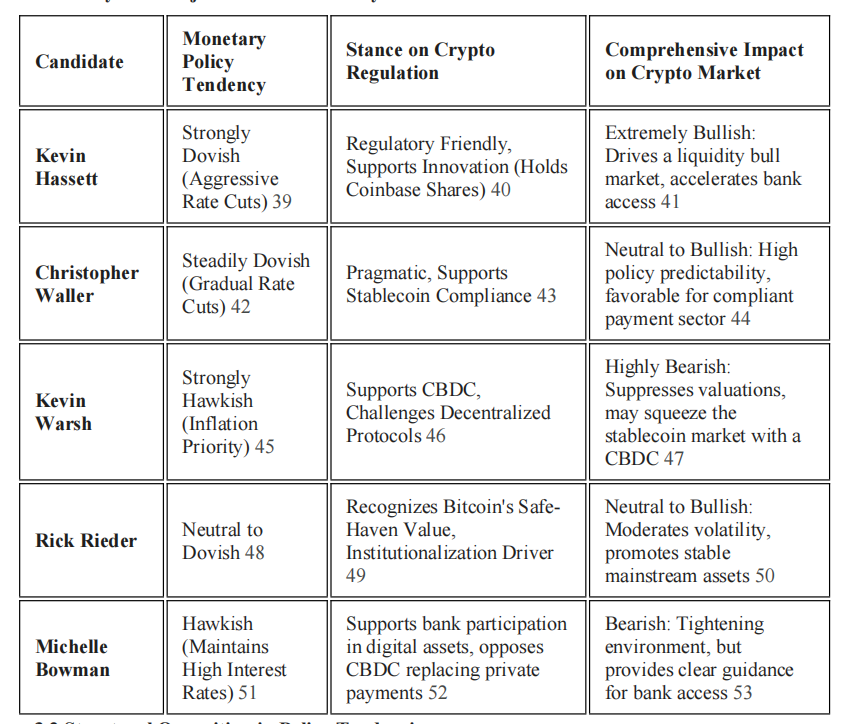
The Structural Impact of the Next Federal Reserve Chair on the Cryptocurrency Industry: Policy Shifts and Regulatory Reshaping
The change of the next Federal Reserve Chair is a decisive factor in reshaping the future macro environment of the cryptocurrency industry.
Trending news
MoreCrypto prices
More






