
Tornado Cash’s Roman Storm Faces 5 Years for a Crime DOJ Now Says It Won’t Prosecute

A top Department of Justice official told an audience of crypto industry leaders Thursday that the U.S. government will no longer charge decentralized software developers with a particular crime—the same crime federal prosecutors successfully convicted Tornado Cash co-founder Roman Storm of earlier this month.
The charge, U.S. code 1960(b)(1)(C), prohibits operators of unlicensed money transmitting businesses from dealing in funds known to have been derived from a crime, or intended to be used to support unlawful activity. Just weeks ago, a Manhattan jury found Storm guilty of violating the law, a crime which carries a penalty of up to five years in federal prison. The jury failed to reach a verdict on all other counts.
Today in Jackson Hole, Wyoming, Matthew Galeotti—the acting head of the DOJ’s criminal division—told a group of crypto lobbyists and industry leaders gathered for a policy summit that federal prosecutors will no longer pursue 1960(b)(1)(C) charges against developers of decentralized software.
“Where the evidence shows that software is truly decentralized and solely automates peer-to-peer transactions, and where a third party does not have custody and control over user assets, new 1960(b)(1)(C) charges against a third party will not be approved,” he said.
The official added that if criminal intent is present in such instances, though, “other charges may be appropriate.”
Galeotti made a point of noting that the new policy will be implemented by the DOJ “going forward,” in a potential nod to Storm’s conviction on the very same charge earlier this month.
Storm was arrested and charged with several crimes in 2023, including conspiracy to commit money laundering and sanctions violations, for his role in operating Tornado Cash—a coin mixing service that allows crypto users to make private on-chain transactions.
When the Trump administration took over Storm’s case earlier this year, it did drop a single charge related to operating an unregistered money transmitting business—but kept the charge accusing the developer of operating Tornado Cash while knowing some of its users were processing funds linked to criminal activity.
That shift was consistent with a DOJ memo circulated in April that instructed federal prosecutors to back off most crypto-related cases—but not necessarily all.
Crypto lobbyists and industry leaders gathered today for Galeotti’s announcement hailed it, cheering him enthusiastically as soon as his speech finished. They were gathered in Wyoming for the inaugural summit of the American Innovation Project, a new pro-crypto nonprofit backed by some of the industry’s most powerful policy players.
Amanda Tuminelli, executive director of the DeFi Education Fund, a crypto lobbying group, was one industry attendee present for Galeotti’s speech today. In a statement shared with Decrypt, she celebrated the DOJ policy change and thanked the Trump department for “hearing our concerns about Section 1960.”
“The fact the DOJ acknowledged that software developers should not be held responsible for third party’s misuse of their code affirms what we have been advocating for years,” she said.
Others, though, were less optimistic. Coin Center Executive Director Peter Van Valkenburg similarly expressed gratitude for Galeotti’s statements in a post on X but lamented the fact that it’s seemingly “a little late” in Roman Storm’s case.
“I'm especially interested if the DOJ keeps fighting when Roman appeals his unlicensed money transmission verdict. If so, what is this speech all about?” Van Valkenburg posted. The Coin Center executive, who oversees the non-profit advocacy group, also expressed concern over Galeotti’s “criminal intent” caveat and noted that the DOJ official’s statements are in no way binding.
In recent months, DeFi and privacy advocates have walked a tightrope, praising the Trump administration for its pro-crypto policy shifts in most instances, but also expressing existential concern about the implications of Storm’s prosecution and conviction by the president’s DOJ.
After Galeotti’s speech this afternoon, the DOJ official participated in an off-the-record Q&A with crypto industry leaders in the room. A source present at the event told Decrypt Galeotti received no questions about the Roman Storm case.
Disclaimer: The content of this article solely reflects the author's opinion and does not represent the platform in any capacity. This article is not intended to serve as a reference for making investment decisions.
You may also like
A World Beyond SWIFT: Russia and the Hidden Crypto Economy
In a country isolated by the Western financial system, "stablecoin"—a term that once appeared only in Silicon Valley whitepapers—has quietly become a foundational infrastructure that ordinary people and businesses truly rely on.

Mysterious Banners in the Moscow Metro: Who Is Putting the Russian Economy "On-Chain"?
The article reveals how, under Western financial sanctions, the crypto economy has become an important financial tool for businesses and individuals in Russia, with stablecoins such as USDT playing a key role in both the black market and legitimate trade. Summary generated by Mars AI. This summary was generated by the Mars AI model, and the accuracy and completeness of the content are still being iteratively updated.

Behind the Moore Threads Wealth Boom: Co-founder Li Feng's "Crypto" History
Before Moore Threads was listed on the STAR Market, Li Feng had another secret history in the crypto space.

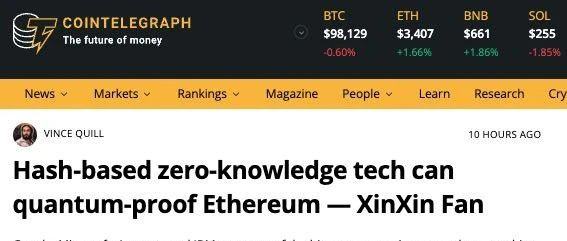
Dr. Xinxin Fan, Head of Research and Development at IoTeX, wins ICBC Best Paper Award for his quantum-safe paper, which will be first applied to the IoTeX blockchain network.
IoTeX Head of Research Dr. Xinxin Fan co-authored a paper titled "Enabling a Smooth and Secure Post-Quantum Transition for Ethereum," which was awarded Best Paper at the 2024 International Conference on Blockchain (ICBC 2024).
Trending news
MoreCrypto prices
More





