
Bitcoin’s Record Run Reverses After $19B Futures Wipeout and Cooling ETF Inflows

Bitcoin’s rapid surge to an all-time high of $126,100 has been abruptly reversed , following one of the largest futures deleveraging events in history and weakening ETF inflows that signal cooling institutional appetite.
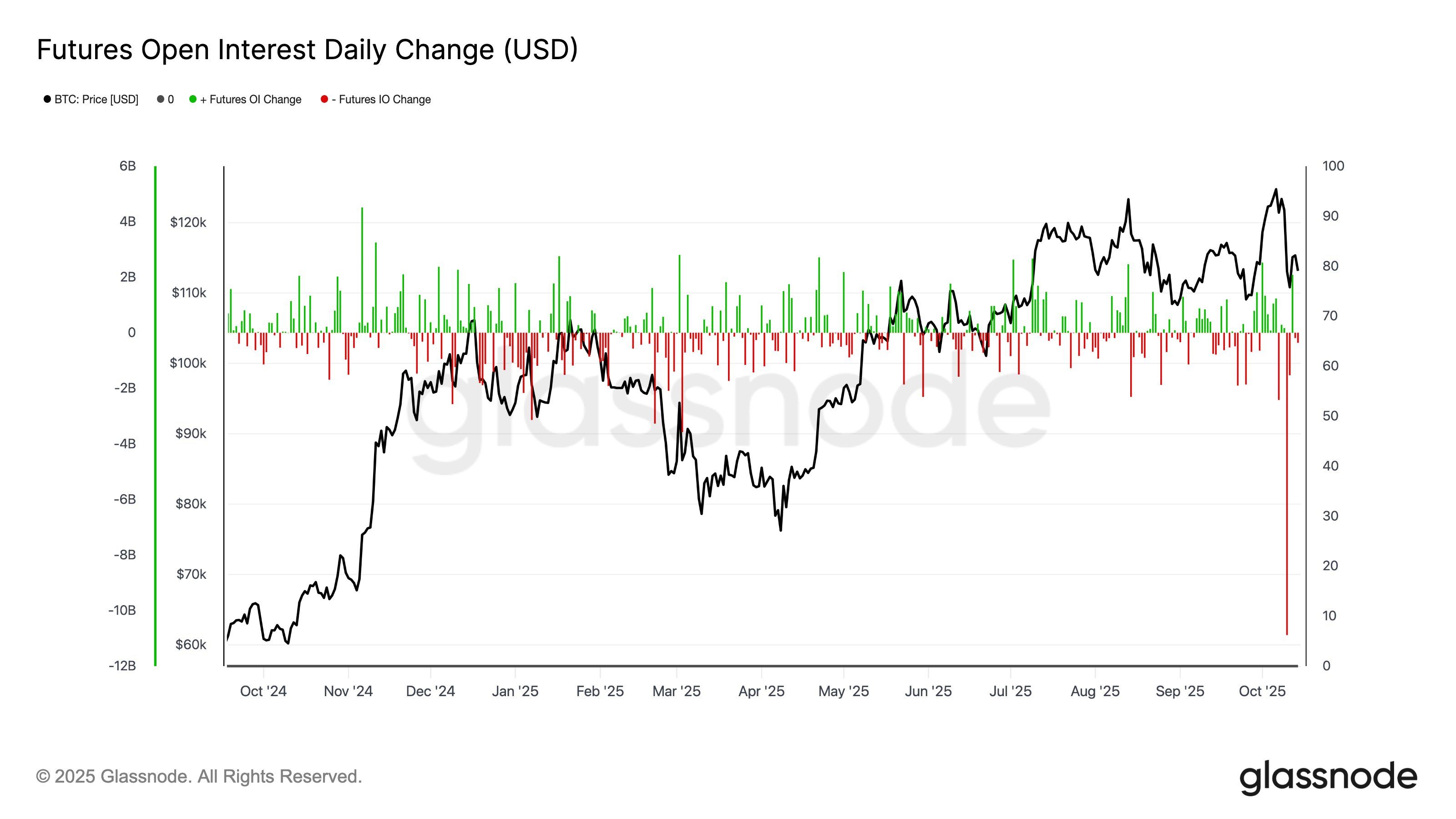 Bitcoin’s Record Run Reverses. Source: Glassnode
Massive leverage flush hits bitcoin derivatives
According to Glassnode’s latest on-chain report, over $19 billion in futures open interest was wiped out amid intensifying macroeconomic concerns, including renewed U.S.–China tariff tensions. The crash sent Bitcoin tumbling below the $117,000–$114,000 cost-basis zone.
The Estimated Leverage Ratio collapsed to multi-month lows as traders rapidly unwound positions, echoing the 2021 and 2022 market flushes. Funding rates also plunged to FTX-era lows, showing traders were paying to stay short after bullish leverage evaporated. Analysts described the event as a structural reset rather than a full capitulation — a necessary purge of excess leverage that could restore long-term stability.
Spot trading volumes surged during the drawdown, with Binance leading the sell pressure while Coinbase saw institutional buying, suggesting U.S.-based investors absorbed some of the shock. Despite heightened volatility, Glassnode noted the sell-off was “sharp but orderly,” underscoring that the market remains cautious but not in panic.
Institutional demand weakens as volatility returns
While derivatives markets faced a historic purge, ETF inflows turned negative by 2,300 BTC, marking a decline in institutional demand that had previously fueled Bitcoin’s record highs. Long-Term Holders (LTHs) have also continued to distribute since July, adding steady sell-side pressure as the market enters a consolidation phase.
Meanwhile, Bitcoin options markets saw open interest rebound swiftly, even as volatility spiked to 76% and short-term skew flipped sharply positive — signaling traders’ rush to hedge downside risks.
Bitcoin now sits in a fragile recovery zone, with analysts warning that a drop below $108,000 could deepen the correction unless renewed ETF inflows and on-chain accumulation restore momentum.
Still, beneath the turbulence, confidence among corporates remain strong — the number of publicly traded companies holding Bitcoin rose 38% between July and September, signaling that institutional conviction, while cooling short term, remains structurally intact.
Take control of your crypto portfolio with MARKETS PRO, DeFi Planet’s suite of analytics tools.”
Disclaimer: The content of this article solely reflects the author's opinion and does not represent the platform in any capacity. This article is not intended to serve as a reference for making investment decisions.
You may also like

Why is the short seller who made $580,000 now more optimistic about ETH?

The truth behind Bitcoin's overnight 9% surge: Is December the turning point for the crypto market?
Bitcoin strongly rebounded by 6.8% on December 3 to $92,000, while Ethereum surged 8% to break through $3,000, with mid- and small-cap tokens seeing even larger gains. The market rally was driven by multiple factors, including expectations of a Federal Reserve rate cut, Ethereum’s technical upgrades, and policy shifts. Summary generated by Mars AI. This summary was produced by the Mars AI model, and the accuracy and completeness of its content are still in the process of iterative updates.

Even BlackRock can't hold on? BTC ETF sees $3.5 billion outflow in a single month as institutions quietly "deleveraging"
The article analyzes the reasons behind cryptocurrency ETF outflows in November 2025 and their impact on issuers' revenues, comparing the historical performance of BTC and ETH ETFs as well as the current market situation. Summary generated by Mars AI. This summary is produced by the Mars AI model, and the accuracy and completeness of its generated content are still being iteratively updated.
Trending news
MoreCrypto prices
More






