
Vitalik Buterin Urges ZK and FHE Developers to Share Efficiency Ratios

Quick Take Summary is AI generated, newsroom reviewed. Vitalik Buterin wants ZK/FHE developers to report an 'efficiency ratio'. The ratio is cryptographic computation time compared to raw computation time. This metric is more hardware-independent and shows the cost of adding cryptographic security. The call highlights the need for a common performance language across cryptography projects.References I wish more ZK and FHE people would give their overhead as a ratio (time to compute in-cryptography vs time
Ethereum co-founder Vitalik Buterin has called on developers. Those working in zero-knowledge (ZK) and fully homomorphic encryption (FHE) technologies to adopt a clearer way of reporting performance data. In a post shared on X today, Buterin suggested that teams should express efficiency as a ratio.
He compares cryptographic computation time to raw computation time. Rather than only stating how many operations per second they can perform. He explained that this ratio-based approach would help developers better understand. To how much efficiency they lose when replacing traditional trust-based systems with cryptographic methods.
Buterin Calls for Transparent Efficiency Metrics
Vitalik Buterin emphasized that using ratios offers a more hardware independent and informative benchmark. He noted that developers already know how long their computations take to process normally. Therefore, if they know the efficiency ratio, they can easily calculate the expected performance overhead of cryptographic operations.
“It gives a very informative number: how much efficiency am I sacrificing by making my app cryptographic instead of trust-dependent?” Buterin wrote. He acknowledged that this measurement is not perfect since different operations. Especially those involving parallelization or memory access, can vary across hardware setups. Still, he believes the ratio method provides a more universal standard for comparing different ZK and FHE implementations.
Developers Weigh In on Benchmark Challenges
Following his post , several cryptography experts joined the discussion. Lukas Helminger pointed out that benchmarking FHE systems can be more complex than ZK ones. Because of variables like network configurations and the number of participating parties. Vitalik Buterin responded by clarifying that FHE typically involves a single party.
Except for limited instances like input submission or final threshold decryption. These processes, he said, are not directly proportional to computational workloads. Helminger agreed but added that for blockchain use cases. The performance of threshold decryption still depends on network size. Buterin concurred, suggesting that bandwidth requirements and network latency should also be measured. To give a realistic picture of performance in deployed systems.
Standardizing Metrics Across Cryptography
Other researchers echoed Vitalik Buterin’s call for standardization. Matt McAteer noted that proof size ratios, comparing proof bytes to computation size. These are equally important for understanding scalability in ZK systems. Muhammad Azhar added that efficiency ratios could help unify comparisons across different hardware and cryptographic schemes. He argued that relying only on raw operations-per-second benchmarks hides the real-world performance impact. Particularly for applications needing low latency.
Pushing for a Common Performance Language
Vitalik Buterin’s comments highlight an ongoing challenge in cryptography. The lack of consistent metrics for comparing performance across different schemes and hardware. As ZK proofs and FHE continue gaining traction in blockchain, AI and privacy-focused applications. Standardized benchmarks could accelerate progress and transparency. By encouraging developers to publish efficiency ratios. Buterin aims to bring clarity to a complex field. One where the cost of privacy and security is often hidden behind impressive sounding performance numbers.
Disclaimer: The content of this article solely reflects the author's opinion and does not represent the platform in any capacity. This article is not intended to serve as a reference for making investment decisions.
You may also like
Fed Cuts Rates, Announces $40B T-Bill Program, Crypto Dips
U.S. Marine Policy and Blue Economy Prospects: Key Infrastructure and Geostrategic Roles in Oceanic Commerce
- U.S. oceans policy balances geopolitical strategy, deep-sea tech investments, and UNCLOS ratification challenges to secure maritime influence. - Executive actions accelerate seabed mineral extraction while facing environmental criticism and legal risks from bypassing international seabed authority rules. - Offshore energy partnerships with Australia, Japan, and Saudi Arabia aim to diversify supply chains but face geopolitical tensions in chokepoints like the Red Sea. - Maritime security contracts expand

Aster DEX's On-Chain Momentum: Signaling the Future of DeFi
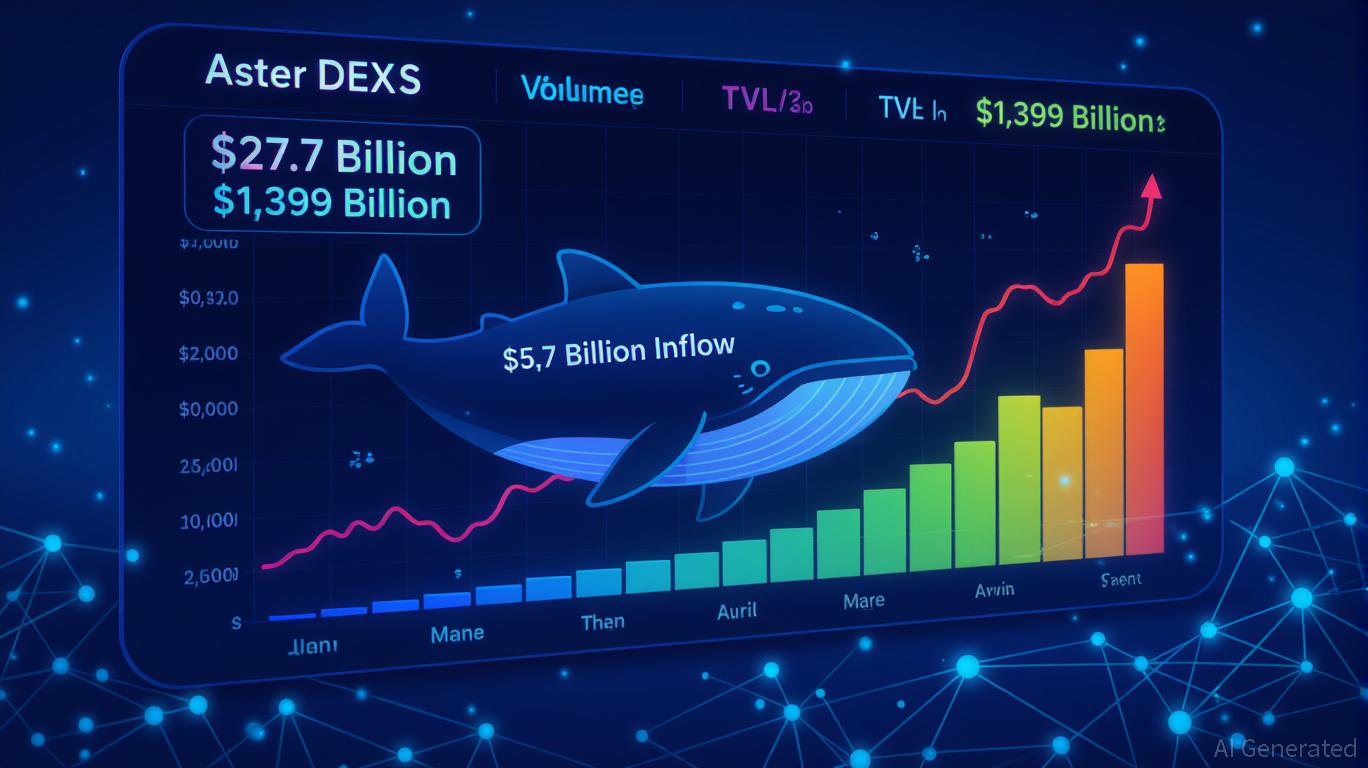
- Aster DEX reported $27.7B daily volume and $1.399B TVL in Q3 2025, outpacing DeFi benchmarks with 2M users. - Institutional whale activity, including CZ's $2M ASTER purchase, drove $5.7B inflows and 800% volume spikes. - Hybrid AMM-CEX model and ZKP privacy tech enabled 40.2% TVL growth, 77% private transactions, and 19.3% perpetual DEX market share. - ASTER's margin trading upgrades and Stage 4 airdrops fueled 30% price surges, while Aster Chain's 2026 launch will integrate privacy-preserving ZKPs. - On
Astar (ASTR) Price Rally: Protocol Enhancements and Ecosystem Growth Drive Long-Term Value
- Astar (ASTR) surged 150% due to protocol upgrades and ecosystem expansion, positioning it as a sustainable value creation case study in blockchain. - Tokenomics 3.0 (fixed 10.5B supply) and Burndrop mechanism created deflationary incentives, supported by Galaxy Digital's $3. 3M OTC investment and Astar's $29.15M buyback. - Cross-chain interoperability with Polkadot/Plaza and Sony's Soneium, plus partnerships with Toyota and Japan Airlines, expanded real-world utility in logistics, identity, and loyalty p

Trending news
MoreCrypto prices
More





