
How Bitcoin Hype Left Retail Buyers $17 Billion Poorer

A recent 10X Research report has estimated that retail investors lost about $17 billion due to their exposure to Bitcoin treasury companies.
The losses reflect a broader decline in investor enthusiasm for Digital Asset Treasury Companies (DATCOs). Firms such as MicroStrategy and Metaplanet have seen their stocks tumble in tandem with Bitcoin’s recent price slump.
Bitcoin Treasury Firms Wiped Out $17 Billion in Retail Wealth
According to the report, many investors turned to these DATCOs to gain indirect exposure to Bitcoin. These firms typically issue shares at a premium to their underlying Bitcoin holdings, using the raised capital to buy more BTC.
10x Research noted that the strategy worked well when Bitcoin’s price rose, as stock valuations often outpaced the asset’s spot gains. However, as market sentiment cooled and Bitcoin’s momentum faded, those premiums collapsed.
As a result, investors who bought during the frenzy of inflated valuations have collectively lost about $17 billion. The firm also estimated that new shareholders overpaid for Bitcoin exposure by roughly $20 billion through these equity premiums.
These numbers are unsurprising considering BeInCrypto previously reported that global companies have raised over $86 billion in 2025 to buy cryptocurrencies.
Notably, this figure surpasses the total US initial public offerings this year.
Yet, despite this massive inflow, the performance of Bitcoin-linked equities has recently lagged behind the broader market.
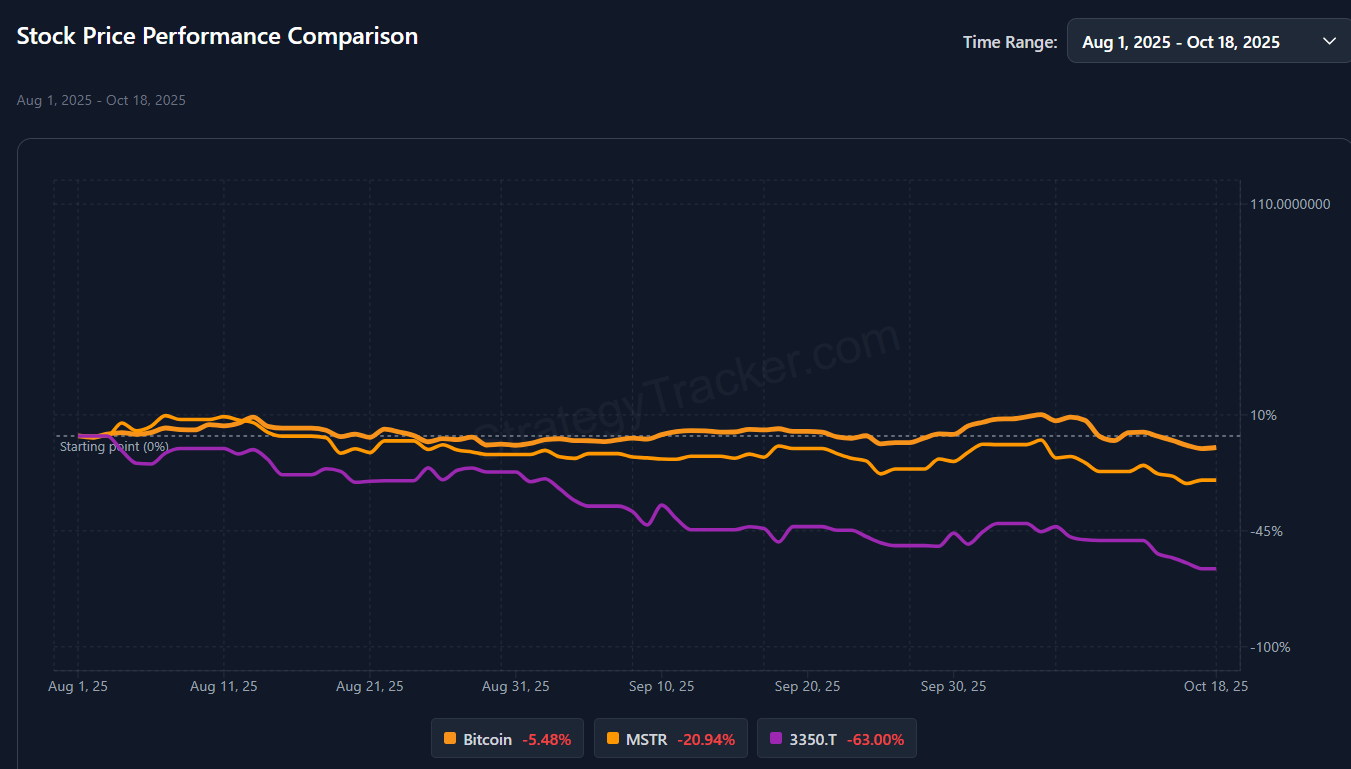
For context, Strategy’s (formerly MicroStrategy) MSTR stock has fallen more than 20% since August. Tokyo-based Metaplanet, according to Strategy Tracker data, also lost over 60% of its value during the same period.
Bitcoin DATCOs mNAVs Decline
At the same time, their market-to-net-asset-value (mNAV) ratios, once a measure of investor confidence, have also deteriorated.
MicroStrategy now trades around 1.4x its Bitcoin holdings, while Metaplanet has slipped below 1.0x for the first time since adopting its Bitcoin treasury model in 2024.
“Those once-celebrated NAV premiums have collapsed, leaving investors holding the empty cup while executives walked away with the gold,” 10x Research stated.
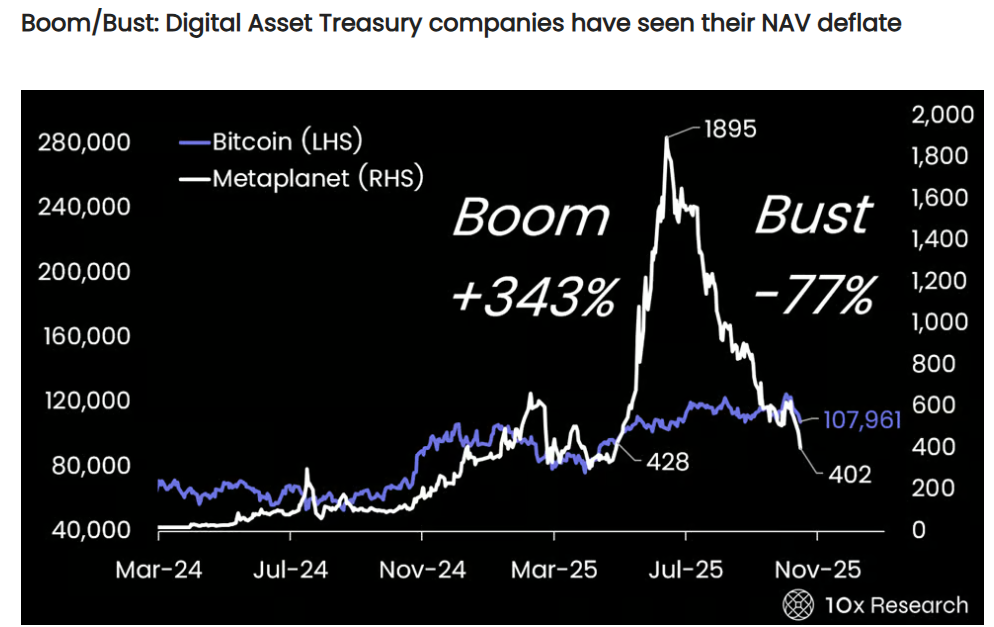
Across the market, nearly one-fifth of all listed Bitcoin treasury firms reportedly trade below their net asset value.
The contrast is striking given that Bitcoin recently hit a record high above $126,000 this month before pulling back after President Donald Trump’s tariff threats against China.
Still, Brian Brookshire, head of Bitcoin strategy at H100 Group AB, argued that mNAV ratios are cyclical and do not reflect long-term value. H100 Group AB is the largest Bitcoin-holding firm in the Nordic region.
“Most BTCTCs trading near 1x mNAV have only arrived there within the past couple weeks. By definition, not a norm…even for MSTR, there is no such thing as a normal mNAV. It’s a volatile, cyclical phenomenon,” he said.
Nonetheless, analysts at 10X Research said the current episode marks “the end of financial alchemy” for Bitcoin treasuries, where inflated share issuance once created the illusion of limitless upside.
Considering this, the firm stated that these DATCOs will now be judged by earnings discipline rather than market euphoria.
“With volatility falling and the easy gains gone, these firms face a hard pivot from marketing-driven momentum to real market discipline. The next act won’t be about magic—it will be about who can still generate alpha when the audience stops believing,” 10X Research concluded.
The post How Bitcoin Hype Left Retail Buyers $17 Billion Poorer appeared first on BeInCrypto.
Disclaimer: The content of this article solely reflects the author's opinion and does not represent the platform in any capacity. This article is not intended to serve as a reference for making investment decisions.
You may also like
Spyware developer NSO Group banned from accessing WhatsApp
Meet the AI Stock Outperforming Nvidia and Palantir in 2025

Trending news
MoreCrypto prices
More






