
Tech Giants Dominate S&P 500, Raising Risk Alerts

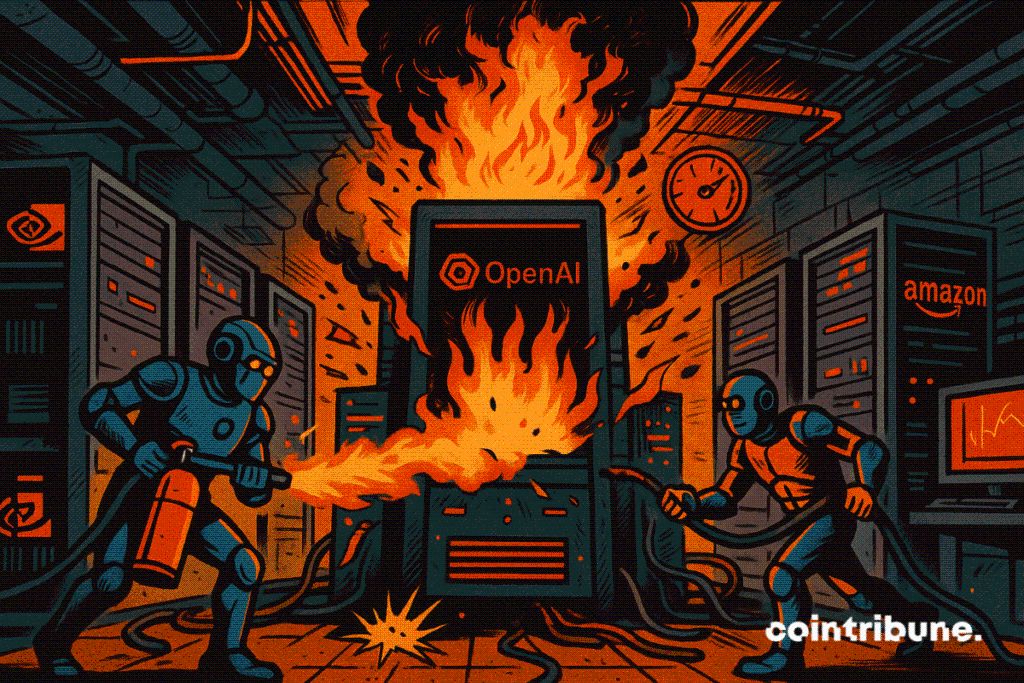
Valuations of artificial intelligence are soaring, sometimes without profitability to support them. Voices are rising, recalling the excesses of the 2000 Internet bubble. Disproportionate weight of sector giants in indices, massive investments, widespread enthusiasm: signs of a possible overheating are accumulating. In this climate of euphoria, a question reemerges : is AI the engine of a new economic era or that of a speculative bubble ready to burst ?
In brief
- Valuations in the artificial intelligence sector are reaching record levels, despite the lack of profitability for the majority of companies.
- Institutions like the IMF, the Bank of England, and JPMorgan warn of a possible rush comparable to the 2000 Internet bubble.
- Alarming market ratios, extreme concentration in indices, and the massive arrival of individual investors increase concerns.
- Colossal investments in AI infrastructure raise fears of overcapacity, while concrete economic returns remain limited.
Giants valued at a loss
At the end of August, Sam Altman, founder of OpenAI, expressed his own doubts about the frenzy surrounding artificial intelligence and promised a more human AI . “Are we in a phase where investors overall are overexcited about artificial intelligence? I think so,” he declared .
A few weeks later, his startup, still not publicly listed and unprofitable, was valued at $500 billion, an unprecedented level for a company of this profile. This stratospheric valuation is not an isolated case. Tech giants Apple, Nvidia, Microsoft, Alphabet, and Amazon now concentrate nearly 30 % of the total S&P 500 capitalization, a historic weight in the markets.
In this context, the International Monetary Fund, the Bank of England, and several major banks publicly question a possible overheating comparable to that observed in the late 1990s.
Market indicators reveal several objective signs of euphoria, according to consistent analyses :
- The S&P 500 price/earnings ratio is now 23, a level close to the peak of 25 reached just before the bursting of the Internet bubble in 2000 ;
- The total equity value of American companies represents 363 % of nominal GDP in the second quarter of this year, an all-time record, significantly higher than the 212 % peak in the first quarter of 2000 ;
- The IMF warns that a “disappointment caused by AI results” could lead to a sharp market revaluation of tech stocks.
Through these on-chain data, it is the growing disconnect between market capitalization and real profitability that worries. While AI promises significant productivity gains, its concrete effects on profits remain largely speculative for the time being.
The explosion of expenses and the concentration of technological power
Beyond disconnected valuations, it is now the sector’s internal dynamics that fuel concerns. According to the Gartner firm, global investments in AI infrastructure are expected to reach $1.5 trillion this year , mainly directed towards data centers and computer hardware in the United States.
This investment volume recalls that of the 2000s in fiber optics and telecommunications. However, the lack of profitability triggers distrust : “80% of companies in the AI field are not profitable,” observes Alexandre Baradez, analyst at IG.
Added to this is another phenomenon: the circularity of agreements between major players. In one month, OpenAI signed a $100 billion deal with Nvidia , then announced the purchase of equipment worth several billion from AMD, before considering a partnership with Broadcom. These cross operations, considered by some as “incestuous,” evoke speculative mechanisms observed during the Dotcom bubble.
The very structure of the market has evolved, with a record involvement of individual investors. More than 35% of American shares are now held by individual investors, a figure much higher than that observed in 2000.
These data translate a potential overestimation of growth prospects, at a time when the IMF anticipates only 2 % growth for the United States in 2026. Furthermore, a “strong acceleration of earnings per share seems unlikely,” according to a note from the Swiss private bank J. Safra Sarasin.
While the analogy with the Internet bubble cannot be mechanically established, current leaders such as Microsoft, Alphabet, Amazon, or Nvidia, whose capitalization reaches $4.68 trillion, driven by AI demand , are largely capitalized and much stronger than the precarious startups of 2000, the scenario of a sharp revaluation remains credible. In sum, the question is whether its current valuation rests on sufficiently solid foundations to avoid a collapse.
Disclaimer: The content of this article solely reflects the author's opinion and does not represent the platform in any capacity. This article is not intended to serve as a reference for making investment decisions.
You may also like
Algo slips 0.52% as Allego unveils app designed to simplify EV charging
- Algo (ALGO) fell 0.52% in 24 hours to $0.1335, with a 60.3% YTD decline, coinciding with Allego's new EV charging app launch. - Allego's app offers real-time pricing, smart routing, and Plug&Charge features to simplify European EV charging across 35,000+ stations. - The app eliminates partner network markups and provides transparent billing, targeting user frustrations with fragmented charging experiences. - As Europe's EV market grows, Allego positions itself as a key infrastructure provider through thi

Exploring How Artificial Intelligence Shapes Higher Education and Tomorrow’s Job Market: Supporting STEM and Technical Training to Counteract the Effects of Automation
- AI is reshaping global economies, forcing higher education and vocational programs to rapidly adapt to automation-driven workforce demands. - Institutions prioritize "AI fluency" across disciplines, while STEM/vocational training addresses growing demand in AI-augmented roles like data analysis and software development. - OECD projects AI education investments could boost GDP, with the AI education market expected to grow from $7.05B in 2025 to $112.30B by 2034. - Federal funding initiatives and private

The Growing Need for AI Professionals and How It Influences Technology Company Valuations
- Global AI talent demand surged in 2025, driving universities to expand AI curricula and industry partnerships. - Top institutions like MIT and Stanford prioritize ethical AI education, while international schools like Nanyang Tech boost AI research. - Universities with AI-focused endowments achieved 14-15.5% returns in 2025, outperforming traditional education assets. - Education ETFs like Leverage Shares +3x Long AI ETP rose 120% in 2025, tracking AI infrastructure growth and semiconductor demand. - AI

MSCI exclusion for MicroStrategy already priced in, according to JPMorgan

Trending news
MoreCrypto prices
More





