
Bitcoin News Update: Crypto Recovery After Crash: Risky Presale Opportunities or Institutional Investment?
- Post-crash crypto rebound sees investors favoring projects with strong fundamentals and high-growth presales like BullZilla, Blazpay, and DeepSnitch AI. - Ethereum rebounds to $3,941.73 amid institutional confidence in Layer-2 upgrades and DeFi dominance, while BNB surges 6% post-CZ pardon. - High-risk presales offer asymmetric returns: $100 in DeepSnitch AI could yield $10,000 if token hits $2 post-launch. - Bitcoin Hyper aims to enhance Bitcoin's scalability via Solana integration, raising $24.4M for Q
After experiencing a $19 billion wave of liquidations in October, the cryptocurrency sector is beginning to rebound, with investors now gravitating toward projects that demonstrate robust fundamentals and significant growth prospects. As
Ethereum (ETH) has staged a recovery from its recent slump, trading at $3,941.73 as of October 22, 2025. Experts credit this resurgence to renewed institutional interest in its Layer-2 ecosystem and anticipation for the December Fusaka upgrade, which is expected to boost scalability by as much as eightfold. Combined with Ethereum’s leadership in decentralized finance (DeFi) and smart contracts, these factors reinforce its reputation as a reliable long-term asset. “Ethereum’s stable transaction fees and staking yields make it a key asset for institutional portfolios,” one analyst commented, adding that pending ETF applications could further drive demand.
Binance Coin (BNB) jumped 6% after the U.S. granted a pardon to Binance founder Changpeng Zhao (CZ), lifting its market value above $157 billion. This development has fueled speculation about changing regulatory attitudes in Washington and has revitalized BNB’s status as the core of the Binance platform. With regular token burns and growing use in DeFi and international payments,
While Ethereum and BNB continue to serve as foundational assets, the sector’s volatility and regulatory ambiguity mean that thorough research is essential. As Geoff Kendrick of Standard Chartered pointed out, the October downturn may represent a buying window, with Bitcoin possibly reaching $200,000 by the end of the year.
Disclaimer: The content of this article solely reflects the author's opinion and does not represent the platform in any capacity. This article is not intended to serve as a reference for making investment decisions.
You may also like
Fed Cuts Rates, Announces $40B T-Bill Program, Crypto Dips
U.S. Marine Policy and Blue Economy Prospects: Key Infrastructure and Geostrategic Roles in Oceanic Commerce
- U.S. oceans policy balances geopolitical strategy, deep-sea tech investments, and UNCLOS ratification challenges to secure maritime influence. - Executive actions accelerate seabed mineral extraction while facing environmental criticism and legal risks from bypassing international seabed authority rules. - Offshore energy partnerships with Australia, Japan, and Saudi Arabia aim to diversify supply chains but face geopolitical tensions in chokepoints like the Red Sea. - Maritime security contracts expand

Aster DEX's On-Chain Momentum: Signaling the Future of DeFi
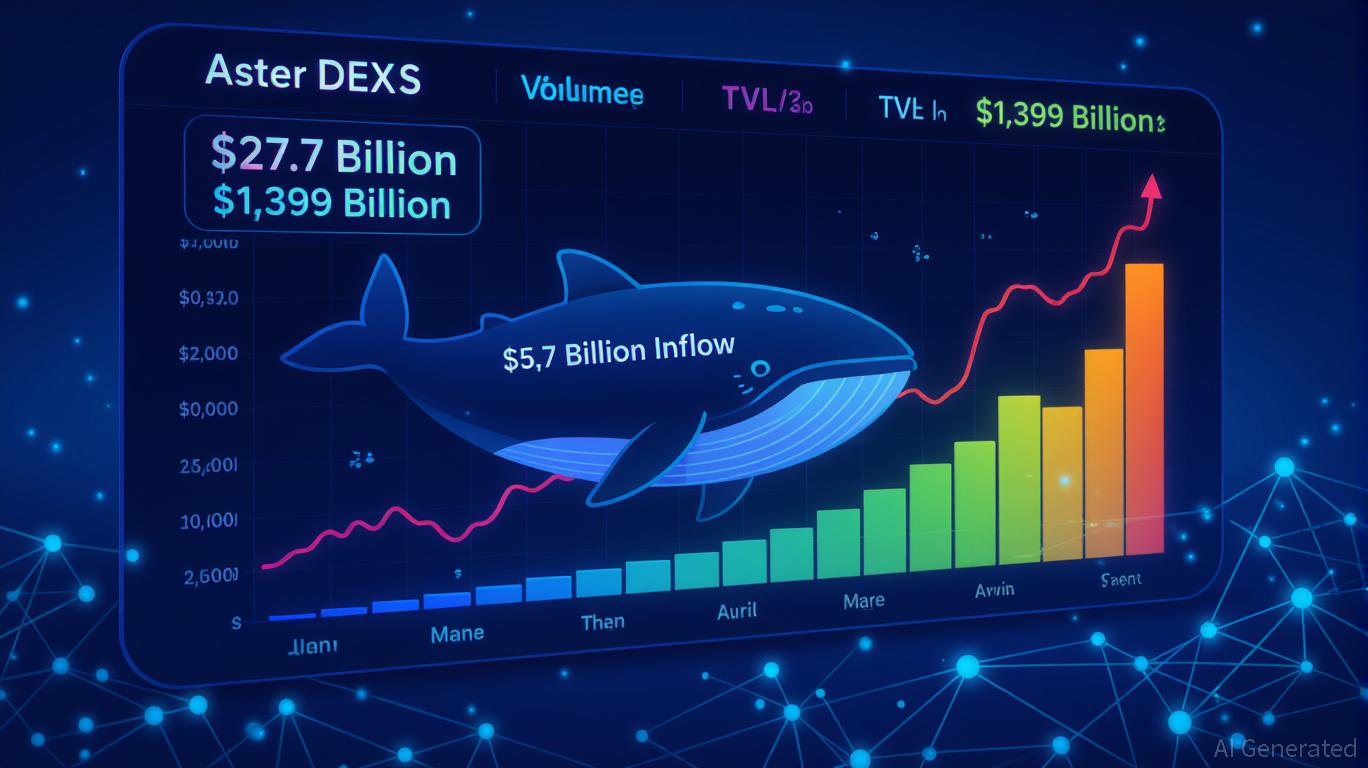
- Aster DEX reported $27.7B daily volume and $1.399B TVL in Q3 2025, outpacing DeFi benchmarks with 2M users. - Institutional whale activity, including CZ's $2M ASTER purchase, drove $5.7B inflows and 800% volume spikes. - Hybrid AMM-CEX model and ZKP privacy tech enabled 40.2% TVL growth, 77% private transactions, and 19.3% perpetual DEX market share. - ASTER's margin trading upgrades and Stage 4 airdrops fueled 30% price surges, while Aster Chain's 2026 launch will integrate privacy-preserving ZKPs. - On
Astar (ASTR) Price Rally: Protocol Enhancements and Ecosystem Growth Drive Long-Term Value
- Astar (ASTR) surged 150% due to protocol upgrades and ecosystem expansion, positioning it as a sustainable value creation case study in blockchain. - Tokenomics 3.0 (fixed 10.5B supply) and Burndrop mechanism created deflationary incentives, supported by Galaxy Digital's $3. 3M OTC investment and Astar's $29.15M buyback. - Cross-chain interoperability with Polkadot/Plaza and Sony's Soneium, plus partnerships with Toyota and Japan Airlines, expanded real-world utility in logistics, identity, and loyalty p
Trending news
MoreCrypto prices
More





