
Affordability Initiatives Challenge the Trade-Off Between Immediate Remedies and Sustainable Strategies
- Rising affordability demands drive policymakers and businesses to implement targeted price controls, supply-side reforms, and expanded cost-reduction programs across sectors. - Paysign Inc. reports $21.6M Q3 revenue surge from patient affordability programs, scaling infrastructure to meet surging demand for healthcare cost solutions. - Wayvia's AI-powered Retail Intelligence platform automates pricing enforcement, aligning with Stanford's call for temporary price controls through data-driven mechanisms.
With voters increasingly prioritizing affordability, both policymakers and businesses are stepping up with focused strategies to rein in expenses. A Stanford economist has recently proposed "short-term, selective price controls" alongside supply-side improvements—a concept now reflected in multiple industries. From healthcare to retail, organizations are broadening their affordability initiatives while
Paysign, Inc., a prominent provider of patient affordability solutions, announced a record $21.6 million in revenue for Q3 2025,

Wayvia Inc. has introduced an enhanced Retail Intelligence platform that uses AI to maintain pricing accuracy in real time. This solution automates MAP (Minimum Advertised Price) tracking and enforces compliance,
President Donald Trump’s administration has recently shifted its stance on trade,
The White House continues to stress long-term economic strategies to "lower expenses and boost real incomes,"
Although affordability programs are gaining momentum, certain risks remain.
The drive for affordability is prompting a multi-pronged approach: businesses are expanding support offerings, governments are revising trade rules, and tech companies are rolling out AI solutions to enforce pricing standards. As the Stanford economist noted, it is crucial to balance short-term actions with sustained supply-side investments. With inflation remaining a concern and public expectations high, the effectiveness of these measures in providing real cost relief will be tested in the months ahead.
Disclaimer: The content of this article solely reflects the author's opinion and does not represent the platform in any capacity. This article is not intended to serve as a reference for making investment decisions.
You may also like
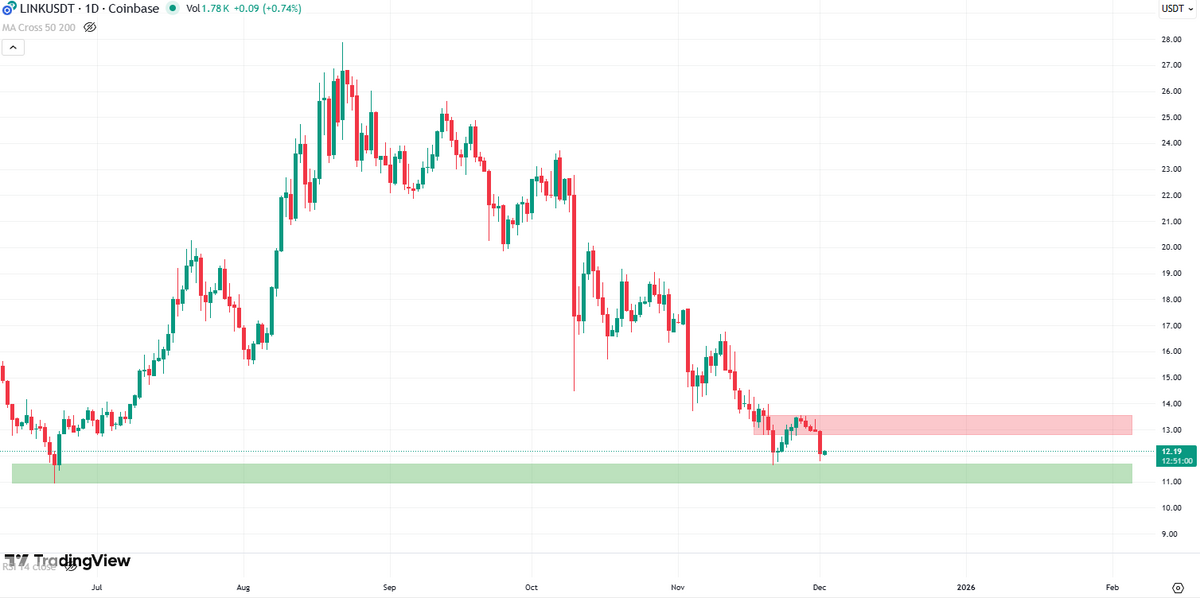
Chainlink ETF Set to Debut as LINK Slips Amid Market Weakness
Striking baristas win $38.9 million in compensation, yet contract disputes continue
- Starbucks settles NYC Fair Workweek Law violations for $38.9M, including $35.5M restitution to 15,000+ workers. - Striking baristas demand collective bargaining amid ongoing labor disputes and unionization efforts at 550 stores. - Mayor-elect Mamdani and Sen. Sanders join protests, framing demands as moral issues against corporate resistance. - Settlement addresses 500,000 scheduling violations since 2021, with workers receiving $50/week compensation. - Starbucks defends labor law complexity but faces cr

Alphabet's AI-driven ecosystem accelerates flywheel momentum, driving shares up by 68% in 2025
- Alphabet's stock surged 68% in 2025, outperforming peers like Microsoft and Nvidia , driven by strong AI monetization and cloud growth. - Analysts raised price targets to $375-$335, citing Google Cloud's $15.2B Q3 revenue (34% YoY) and $155B cloud backlog growth. - The company's AI ecosystem spans Search, YouTube, and Workspace, generating premium subscriptions and ad yield through Gemini's 650M MAUs. - Projected cloud revenue could exceed estimates by $40B, but risks include regulatory scrutiny and comp

XRP News Today: Vanguard Changes Position on Crypto ETFs, Pointing to Market Maturity and Increased Demand
- Vanguard Group will enable crypto ETF trading on its platform from December 2, 2025, reversing years of opposition to digital assets. - The firm supports Bitcoin , Ethereum , XRP , and Solana ETFs but excludes memecoins, treating crypto as non-core assets like gold . - Market maturation, $25B+ ETF inflows, and regulatory compliance drive the shift, positioning Vanguard as the last major U.S. broker to adopt crypto ETFs. - The move reflects growing institutional confidence in regulated crypto structures a
Trending news
MoreCrypto prices
More





