
Ethereum News Update: Fusaka Upgrade Signals New Era of Unified Scaling for Ethereum
- Ethereum's Fusaka upgrade (Dec 3, 2025) introduces PeerDAS and BPO forks to enhance scalability via reduced data verification costs and incremental rollup capacity expansion. - Gas limit raised to 60M through "Pump The Gas" initiative lowers fees and congestion, while L2 data costs could drop 40-60% to boost developer adoption. - EIP-7917/7951 improves security and UX with deterministic finality and P-256 signatures, aligning Ethereum with fintech standards while reducing node storage demands. - Upgrade
Ethereum Prepares for the Fusaka Upgrade
Scheduled for December 3, 2025, Ethereum's Fusaka upgrade marks a significant milestone in the network’s ongoing efforts to enhance scalability. This update builds upon recent changes, such as the increase of the block gas limit to 60 million, and introduces Peer Data Availability Sampling (PeerDAS). PeerDAS enables validators to confirm rollup data without needing to download entire data blobs, which helps lower bandwidth and storage requirements while boosting transaction capacity.
Alongside PeerDAS, the upgrade incorporates Blob Parameter Only (BPO) forks, allowing Ethereum to gradually expand rollup data capacity. This approach avoids the disruptive, large-scale hard forks of the past and supports a smoother transition to higher throughput. These advancements are in line with Ethereum’s broader roadmap—known as the Surge, Verge, and Purge—which aims to create a modular blockchain ecosystem capable of processing over 100,000 transactions per second through layer-2 (L2) solutions.
Recent Gas Limit Increase and Its Impact
In November 2025, Ethereum’s gas limit was raised to 60 million after receiving support from 513,000 validators. This move, part of the “Pump The Gas” campaign led by developers Eric Connor and Mariano Conti, has already improved the network’s base-layer throughput. The primary goals are to lower transaction fees and reduce congestion during busy periods. While this change temporarily increases block size, the Fusaka upgrade will make these scalability improvements permanent, ensuring Ethereum can meet the demands of decentralized finance (DeFi), gaming, and social applications.
Transforming the Layer-2 Ecosystem
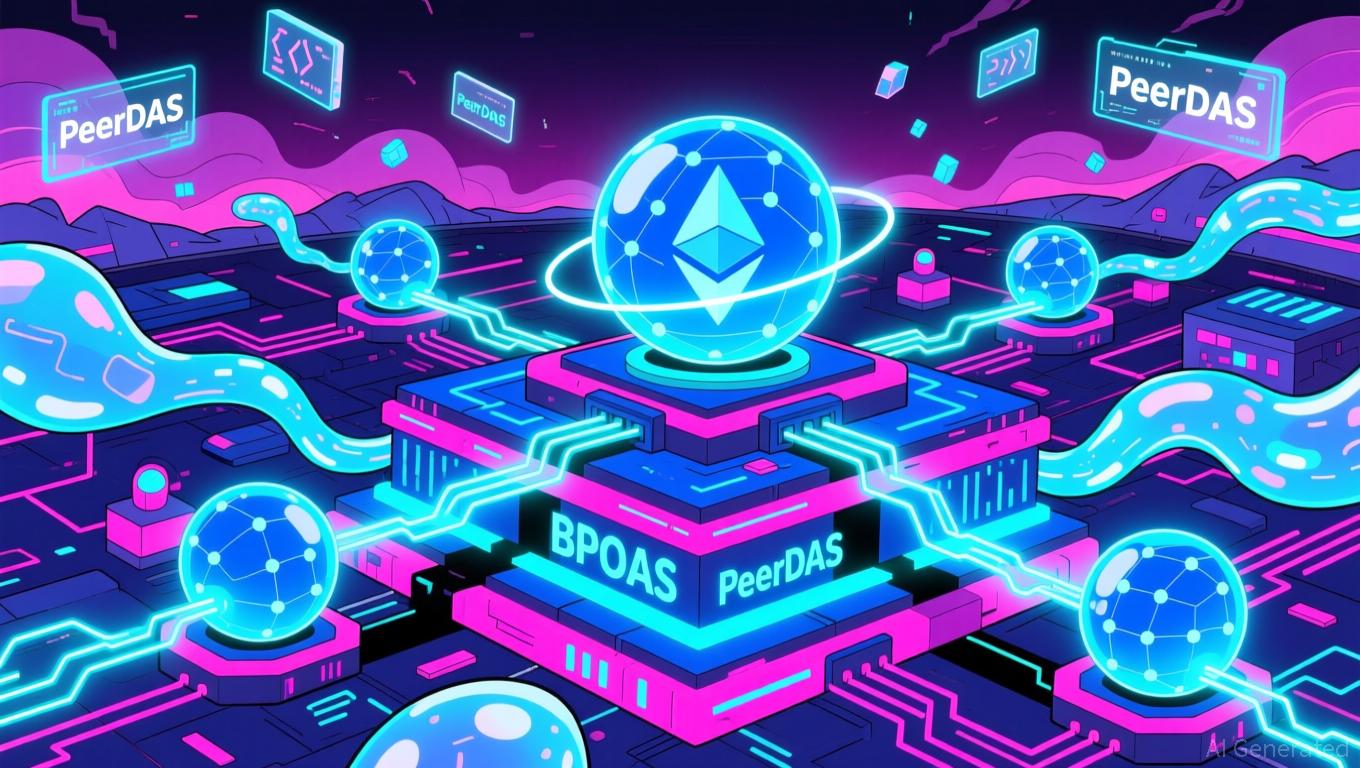
The Fusaka upgrade is expected to have a major effect on L2 networks. PeerDAS and BPO forks are projected to reduce data fees by 40% to 60% over time, encouraging more developers to utilize Ethereum’s rollup infrastructure. Experts predict this will spark increased competition among L2 solutions, leading to better user experiences and lower costs. Meanwhile, Ethereum’s main chain is evolving into a high-capacity settlement platform, with updated blob pricing and minimum fees designed to keep more activity on-chain.
Enhancing Security and User Experience
Several Ethereum Improvement Proposals (EIPs) are included in the upgrade to improve both security and usability. EIP-7917 introduces deterministic proposer lookahead, strengthening soft finality for rollups. EIP-7951 adds native support for P-256 signatures, aligning Ethereum with widely used fintech authentication standards. Additionally, EIP-7642 extends history expiry, reducing storage needs for nodes and making it easier for new validators to participate. However, some critics warn that increasing complexity and a stronger focus on monetization could make the network less accessible if improvements in cost and usability are not clearly communicated to users.
Market Response and Future Outlook
Ethereum’s price, recently trading near $2,913 after a 30% monthly drop, reflects a cautious optimism in the market. Despite bearish signals from technical indicators, institutional investors have shown confidence, with $175 million flowing into Ethereum ETFs over two days in late November. Co-founder Vitalik Buterin remains optimistic about Ethereum’s future, suggesting that further gas limit increases could continue to improve scalability while maintaining network security.
What Comes Next: The Glamsterdam Upgrade
The next significant update, Glamsterdam, is planned for 2026. It will introduce enshrined proposer builder separation (ePBS) and block-level access lists (BALs), further refining Ethereum’s approach to maximal extractable value (MEV) and execution efficiency. If Fusaka is implemented as intended, it will mark a shift from isolated upgrades to a unified scaling strategy that balances decentralization with increased throughput, setting the stage for Ethereum’s continued evolution.
Disclaimer: The content of this article solely reflects the author's opinion and does not represent the platform in any capacity. This article is not intended to serve as a reference for making investment decisions.
You may also like
The 2025 Bitcoin Collapse: Underlying Factors and Tactical Considerations for Cryptocurrency Investors
- The 2025 Bitcoin crash erased $1.2 trillion in value, driven by macroeconomic tightening, leverage, and geopolitical tensions. - Financialization linked crypto to traditional markets, exposing systemic risks through institutional entanglements and fragile liquidity. - Regulatory divergence between U.S. pro-blockchain policies and EU MiCAR rules created jurisdictional conflicts and operational misalignment. - Investors must prioritize diversification, monitor regulatory shifts, and prepare for prolonged v

Blockchain’s $6.8 Billion Bet: Will Advancements Outpace Its Security Risks?
- Terminal Finance's collapse exposed blockchain fintech vulnerabilities from delayed tech adoption and security flaws, triggering sector-wide scrutiny. - Naver-Upbit's $6.8B AI-blockchain merger faces challenges after Upbit's $36M Solana breach, mirroring 2019 North Korean-linked attacks. - Balancer's $116M hack revealed systemic DeFi risks, with debates over audit efficacy despite 11 prior security reviews. - Binance's legal troubles and BNB's price slump highlight market skepticism, while initiatives li

Bitcoin News Update: Krugman Links Bitcoin's Decline to Waning 'Trump Trade' Hype
- Bitcoin's 30% drop from October peak linked to fading "Trump trade" speculation, per Nobel laureate Paul Krugman, who frames it as speculative rather than stable value. - BlackRock's IBIT ETF regained $3.2B profit post-$90K rebound, while SpaceX's $105M BTC transfer sparks custodial strategy debates amid market volatility. - Naver's $10B Dunamu acquisition and corporate Bitcoin treasury moves highlight institutional crypto integration, despite $19B industry selloff and regulatory challenges. - Prediction

Bitcoin News Today: "Conflicting Whale Strategies Cast Uncertainty on Bitcoin's Path to $100K"
- Bitcoin's drop below $100,000 coincided with mixed whale strategies, including accumulation, shorting, and exchange deposits, signaling uncertain market direction. - Ethereum whales used 16.08 million DAI to buy 5,343 ETH at $3,010, while Bitcoin whales deposited 9,000 BTC, potentially signaling selling preparation. - Derivatives markets showed conflicting bets, with a $91M BTC short and $36.4M long flip, while ETF inflows ($84M total) hinted at institutional confidence amid macroeconomic risks. - Analys

Trending news
MoreCrypto prices
More





