
Grayscale Says the Four-Year Cycle Is Dead. What Happens Now?

Bitcoin has taken a beating over the past two months, and plenty of traders are whispering the same fear: is the four-year cycle dead, or is a painful multi-year downturn about to hit? Grayscale Research doesn’t think so. In fact, the asset manager is calling for new all-time highs in 2026 and even hints that the move could come as early as next year. Their view lines up with Tom Lee’s bullish stance, creating a rare moment where two major voices in the industry are openly rejecting the doomsday narrative.
Are We Really Leaving the Four-Year Cycle Behind?
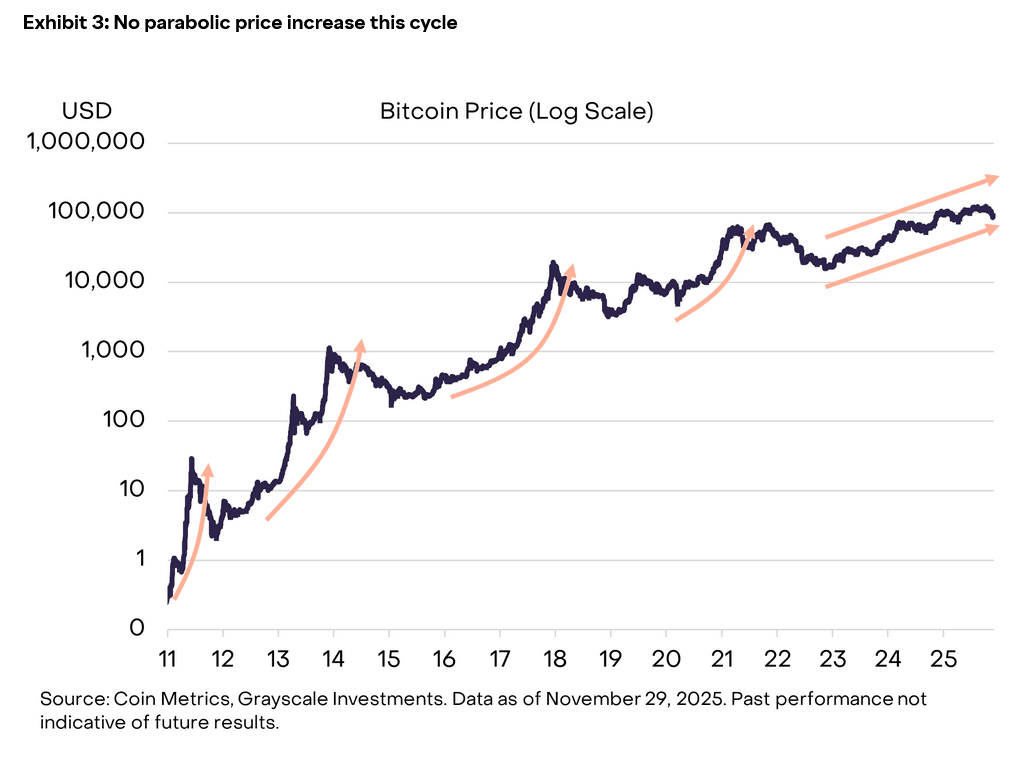
For more than a decade, bitcoin’s price patterns have looked eerily predictable. Every halving delivers a supply shock, retail frenzy kicks in, prices rip into a parabolic peak, and then a brutal reset follows. Grayscale argues that this script no longer fits the market structure we’re living in today. The firm believes the idea that bitcoin must rise and crash on a fixed four-year schedule is outdated and will likely be proven wrong.
What this really means is that bitcoin no longer behaves like a purely speculative retail asset. The current rally hasn’t shown the kind of blow-off top that usually signals the end of a cycle. Instead, the growth has been steadier and more institutional, which changes how corrections unfold and how fast recoveries happen.
Why 2026 Could Deliver New All-Time Highs
Grayscale’s report highlights several shifts that make this cycle fundamentally different. Institutional capital now flows primarily through exchange-traded products and corporate treasuries rather than retail-driven mania on spot exchanges. That creates deeper liquidity, slower emotional swings, and fewer of the violent peaks and crashes that defined earlier eras.
At the same time, the macro backdrop is more cooperative than many assume. Market expectations for rate cuts in 2025 are building, and the political conversation around crypto in the United States is finally showing signs of bipartisan movement. Both create a supportive environment for long-duration assets like bitcoin, giving the market a cushion even during sharp pullbacks.
Volatility Isn’t a Warning Sign, It’s Part of the Playbook
Bitcoin’s dip from its October highs —roughly 32 percent at one stage—has rattled nerves. But Grayscale points out that drawdowns of 25 percent or more are completely normal during bull markets. These periods test investor patience, not the long-term thesis. Monday’s quick drop to $84,000 followed by an immediate recovery above $86,000 shows that deeper structural demand is still present.
The message here is simple: volatility isn’t the start of a collapse. It’s a feature of how bitcoin climbs higher over time. Long-term investors have always had to sit through rough patches before seeing outsized returns.
Tom Lee Says the Market Is Mispriced
Tom Lee, CEO of BitMine , is just as optimistic—maybe even more so. He argues that crypto prices are disconnecting from fundamentals in a way that doesn’t make sense. Wallet growth, on-chain activity, transaction fees, and tokenization adoption are all showing strength even as prices trend lower.
In his view, this mismatch creates one of the most attractive risk-to-reward setups for both bitcoin and ether. On CNBC, he went a step further , claiming bitcoin could hit a new all-time high by January next year. That’s a bold call, but Lee has a history of spotting inflection points early.
If Grayscale and Lee are right, the market is misreading this moment. Instead of spiraling into a multi-year recession, bitcoin might be shifting into a new kind of cycle—one shaped by institutions, regulatory clarity, and a very different macro landscape. That doesn’t mean easy gains or straight-line moves. But it does suggest that the long-term structure is still intact, and maybe even stronger than before.
Pullbacks may feel uncomfortable, but this could be the early stage of $bitcoin’s next significant expansion phase. And if the analysts are right, the next explosive high isn’t years away; it may be right around the corner.
Disclaimer: The content of this article solely reflects the author's opinion and does not represent the platform in any capacity. This article is not intended to serve as a reference for making investment decisions.
You may also like
BNB Latest Updates: YZi Labs Confronts BNC's Board Regarding Mismanagement of BNB Treasury Governance
- YZi Labs, linked to Binance's CZ, seeks to overhaul BNC's board amid a 92% stock price drop and governance disputes. - The firm accuses the current board of operational lapses, delayed filings, and conflicts of interest with 10X Capital. - BNC holds $412M in BNB but trades at a discount as the token's price decline exacerbates shareholder concerns. - YZi's consent solicitation aims to install new directors without a shareholder meeting, potentially reshaping governance. - The outcome could signal broader

Blockchain’s “irreversible” scams can now be tracked: Success in fund recovery is rising
- Crypto fraud victims now recover stolen assets at 58–72% rates within 90 days, driven by blockchain forensics and law enforcement collaboration. - A 2025 U.S. seizure of 127,271 BTC ($11B) marked a turning point, proving irreversible blockchain transactions can be traced and frozen at regulated exchanges. - Advanced tools and cross-agency efforts enable tracing through mixers and cross-chain bridges, but challenges persist: 66% of victims fail to report thefts, and privacy coins limit recovery to <10%. -

C3.ai Shares Rise Despite AI Industry Slump Thanks to Key Partnerships
- C3.ai reported a 25.3% Q3 revenue drop to $70.26M but saw a 35% stock surge after expanding Microsoft partnerships and alliances with Capgemini, Google Cloud, and AWS. - Analysts project 20.5% YoY revenue decline for Q4 2025, with full-year forecasts at $370M-$395M, highlighting challenges converting AI pilots into long-term contracts. - Strategic consumption-based pricing and Azure/Capgemini collaborations aim to boost customer acquisition, though profitability hurdles persist amid competitive pressures

Astar 2.0 and What Lies Ahead for DeFi Advancements
- Astar Network's 2.0 upgrade introduces a capped ASTR supply and deflationary model, aligning with Bitcoin's scarcity to attract institutional investors. - Enhanced cross-chain interoperability via Plaza and partnerships with LayerZero/Chainlink reduces operational complexity for institutions. - Governance reforms and ESG alignment with Japanese firms aim to address regulatory concerns and expand real-world use cases. - Despite progress, legal uncertainties and smart contract risks persist, limiting large

Trending news
MoreCrypto prices
More





