
Can Europe Catch Up to the US in the Stablecoin Race? Bitget CEO Weighs In

US stablecoins control nearly the entire global market, while Europe is only now rolling out MiCA-regulated euro tokens. Bitget CEO Gracy Chen tells BeInCrypto that clear rules give Europe an edge, but only rapid innovation and SEPA-integrated euro stablecoins can help the EU stay competitive in the years ahead.
US stablecoins dominate 99% of the global market. China is pushing ahead with the e-CNY. Europe, backed by MiCA and the first BaFin-regulated euro stablecoin EURAU, wants to close the gap. But can it move fast enough?
BeInCrypto spoke with Gracy Chen, CEO of Bitget, about Europe’s strengths, its regulatory challenges, and whether the EU can still play a leading role in digital finance.
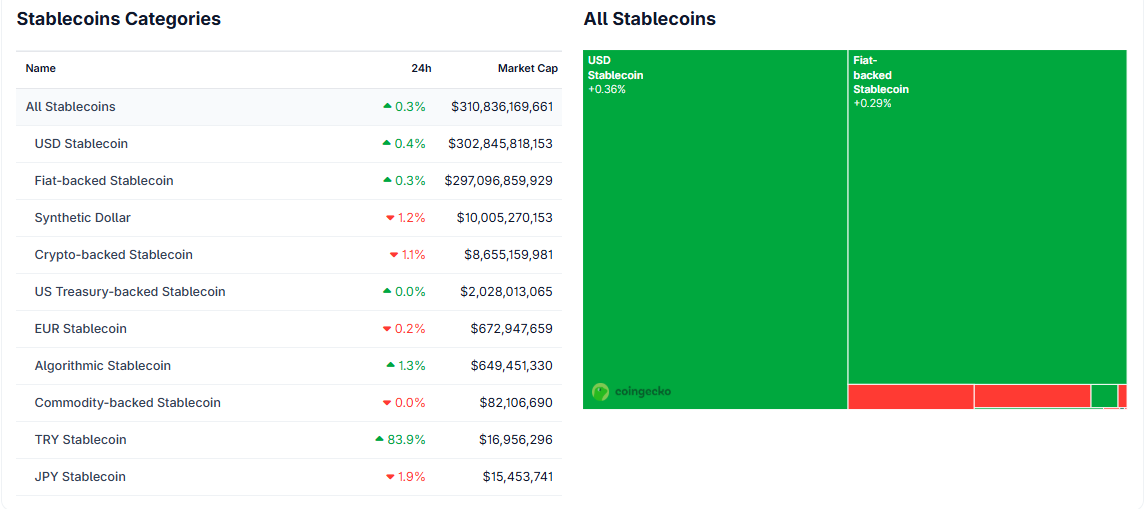 Different Stablecoin Categories. Source:
Europe vs. US: Two Competing Models
BeInCrypto: How do you assess Europe’s position against the US and Asia?
Gracy Chen: Europe is anchored in MiCA, which offers a unified legal framework but demands a high compliance burden. Issuers must maintain full reserves, hold significant capital, and obtain an EMI license. This protects users but raises entry barriers and slows growth.
By contrast, she said, the US GENIUS Act takes a lighter, innovation-first approach. It has allowed private issuers like Circle and Tether to scale rapidly, integrating USDC and USDT into Visa and Mastercard networks.
Asia, meanwhile, remains focused on CBDCs, with private stablecoins still playing a limited role.
Is MiCA Enough to Drive Innovation?
BeInCrypto: Does MiCA foster innovation, or does Europe need more flexibility?
Chen: MiCA is a strong foundation, but Europe needs three adjustments: faster authorization for CASPs and issuers, stronger support for multi-bank reserve models like EURAU, and harmonized implementation across all member states.
Without these, Europe risks regulatory fragmentation and slower adoption.
EURAU and European Sovereignty
BeInCrypto: What does EURAU’s launch mean for Europe?
Chen: EURAU is a pivotal step. As Germany’s first BaFin-regulated euro-backed crypto asset, it provides a compliant alternative to USD stablecoins and strengthens Europe’s monetary sovereignty. Regulatory clarity, she added, is the trigger for institutional adoption and cross-border payment use cases.
What Europe Must Do to Stay Competitive
BeInCrypto: What are the most urgent steps for the EU?
Chen: Europe must shift from policy clarity to operational readiness. The priority is accelerating MiCA-compliant euro stablecoins with native SEPA Instant or TIPS integration, enabling fast, low-cost ramps.
Europe also needs Level-2 standards, EU-wide passporting, and explicit rules for yield-bearing products such as tokenized T-bills — an area where the EU can differentiate from the US.
Infrastructure matters too. Europe needs unified fiat ramps, merchant acceptance programs, interoperability rails, and a common supervisory playbook.
A dedicated stablecoin sandbox and developer toolkits could attract new issuers and close the innovation gap.
Building Trust: Compliance and Technology
BeInCrypto: What builds trust in European stablecoins?
Chen: Transparency and audited reserves. MiCA’s quarterly reporting requirements help prevent the opacity that led to TerraUSD’s collapse.
Mandatory AML/KYC integration and secure, audited smart contracts provide additional assurance for institutions and retail users.
Will Europe Become a Leading Stablecoin Player?
BeInCrypto: Can Europe compete in the next 3–5 years?
Chen: Europe can become a respectable player, but it is unlikely to overtake the US, which already controls almost the entire market through mature private-sector ecosystems. Europe’s advantage lies in its regulatory clarity — but it must accelerate innovation to turn that framework into real adoption.
Regulation Gives Europe a Head Start — Innovation Will Decide the Rest
Europe has what other regions lack: a complete, unified regulatory framework. But rules alone won’t close a 99% market gap.
As Gracy Chen warns, the EU must combine MiCA with speed, infrastructure, and incentives. Whether that is enough to challenge US dominance remains Europe’s defining test — and the answer will come quickly.
Disclaimer: The content of this article solely reflects the author's opinion and does not represent the platform in any capacity. This article is not intended to serve as a reference for making investment decisions.
You may also like
Italy orders non-compliant VASPs to exit as MiCAR rules kick in
Local Leadership and the Drive for Technological Advancement: How Minneapolis is Building Economic Strength
- Minneapolis integrates AI and centralized IT systems to boost municipal efficiency and tech-driven governance. - The city's medical tech sector leads with 16% U.S. talent share and 16 expansion projects in 2024. - Workforce shortages (59% hiring challenges) and rising costs hinder scalability despite innovation gains. - Investors face opportunities in medtech and AI tools but lack transparent metrics for evaluating tech ROI. - Minneapolis highlights the need for balancing tech innovation with accountabil

The Impact of a 30% Increase in ICP Token Value on Investments in Blockchain Infrastructure
- ICP's 30% price surge to $4.71 in November 2025 stems from ICP 2.0 upgrades (Caffeine, Internet Identity 2.0) and institutional partnerships with Microsoft Azure and Google Cloud. - This growth challenges AWS/Azure dominance, with ICP's Fission upgrade enabling scalable decentralized storage and attracting enterprises seeking alternatives to centralized cloud providers. - However, regulatory uncertainty and market volatility (e.g., 91% drop in token transfers during dips) raise questions about long-term

The Economic Impact of Incorporating AI in Sectors Driven by Data
- Global AI infrastructure investments by tech giants like Alphabet and Microsoft are projected to reach $315B in 2025, generating $15T in economic value by 2030 through automation and analytics. - The U.S. leads with $470B in AI infrastructure funding (2013-2024), driven by cloud expansion expected to hit $3.4T by 2040, creating fragmented markets for consolidation. - Data-centric ecosystems (e.g., JHU, ICP Caffeine AI) enable pharmaceuticals and finance firms to build competitive barriers via proprietary

Trending news
MoreCrypto prices
More





