
When "intent" becomes the standard: How can OIF end cross-chain fragmentation and bring Web3 back to user intuition?

Chainfeeds Guide:
OIF is not just a standardization attempt in the intent track, but also a key cornerstone for breaking liquidity silos and switching cross-chain experiences from "manual" to "automatic".
Source:
Author:
imToken Labs
Opinion:
imToken Labs: To understand OIF (Open Intents Framework), one must first recognize the interactive paradigm revolution currently taking place in Web3: a shift from "transactions" to "intents". Traditional on-chain interactions require users to complete every step themselves, such as switching chains, granting permissions, cross-chain transfers, and currency exchanges. Each step requires manual confirmation, gas calculation, and risk monitoring—much like planning your own route from home to the airport: turn left, go straight, get on the overpass, then take the exit. Any mistake in a step could result in extra costs or even loss of funds. The "intent" model is completely different: you only need to describe the desired outcome, such as "I want to swap USDC on Arbitrum for ETH on Base", and the rest of the route planning is handled by professional solvers. Users no longer need to worry about which bridge to choose, how to route, or where liquidity is. However, today's intent ecosystem is extremely fragmented. Each protocol has its own intent format, signature method, and solver logic. UniswapX, CowSwap, and Across all use different "dialects", resulting in high integration costs for wallets and applications. OIF's goal is to end this fragmentation by providing a standardized, general intent framework for the entire Ethereum ecosystem. OIF is not a proprietary protocol of any single project, but a public infrastructure jointly promoted by the Ethereum Foundation along with teams like Across, Arbitrum, and Hyperlane. It defines how intents should be expressed, verified, and settled, enabling any wallet, DApp, or solver to collaborate under the same standard, and supports cross-chain transactions, Dutch auctions, liquidity routing, arbitrage, and other extended trading modes. The biggest difference from existing cross-chain aggregators is that OIF is not a self-contained closed system, but a neutral, auditable open standard. Today's cross-chain aggregators usually define their own intent specifications, decide their own routing, and manage their own bridges and risk controls, so every wallet or DApp must repeatedly adapt to each protocol's API, security assumptions, and business logic, which is extremely inefficient. OIF standardizes these components, so wallets or applications only need to integrate OIF once to connect to all bridges, aggregators, and solvers that adopt this standard. For users, this means a truly "chain-abstracted" experience—no longer needing to think about which chain assets are on, nor performing tedious chain switching, authorization, or cross-chain steps. For example, if you want to buy an Arbitrum NFT on Optimism, the wallet can directly recognize your intent and complete the transaction with solver funding, requiring only a single signature from the user. Currently, OIF's implementation is mainly reflected in standard-setting and ecosystem alliance building. The Ethereum Foundation's EF Protocol team is leading the effort together with Across, Arbitrum, Hyperlane, OpenZeppelin, and other teams, and it will become an important part of the three main themes—"intents, interoperability, account abstraction"—at the 2025 Devconnect. Although ordinary users have not yet directly experienced the improvements brought by OIF, the density of participation and industry attention indicate that the community has reached a consensus: the best wallets and cross-chain capabilities in the future will be built on public frameworks like OIF. The most concrete result of OIF so far is ERC-7683, jointly proposed by Uniswap Labs and Across, which defines a general structure for cross-chain intents and is considered the foundational layer for future cross-chain collaboration and trading. Complementing this is the Ethereum Interoperability Layer (EIL), which provides a trust-minimized messaging channel at the base layer, while OIF provides the intent structure and user experience at the upper layer. Together, they form the core of Ethereum's future multi-chain interoperability stack. The Ethereum Foundation acts as a coordinator, making it clear in its roadmap that OIF is the "initialization phase" of the interoperability narrative, giving the market a strong long-term signal: intents are not a short-term trend, but the core direction for Ethereum over the next decade. As OIF advances, interoperability is evolving from a white paper concept to an auditable, reusable, and massively deployable engineering system. In the future, users may only need to express "what they want to do" without thinking about which chain their assets are on or which bridge to choose—that will be the sign of OIF quietly working behind the scenes at the foundational level.

Disclaimer: The content of this article solely reflects the author's opinion and does not represent the platform in any capacity. This article is not intended to serve as a reference for making investment decisions.
You may also like
ETFs are being launched in clusters, but coin prices are falling. Can ETF approval still be considered good news?
On one hand, Vanguard has opened Bitcoin ETF trading, while on the other hand, CoinShares has withdrawn its applications for XRP, Solana Staking, and Litecoin ETFs, highlighting a significant divergence in institutional attitudes toward ETFs for different cryptocurrencies.

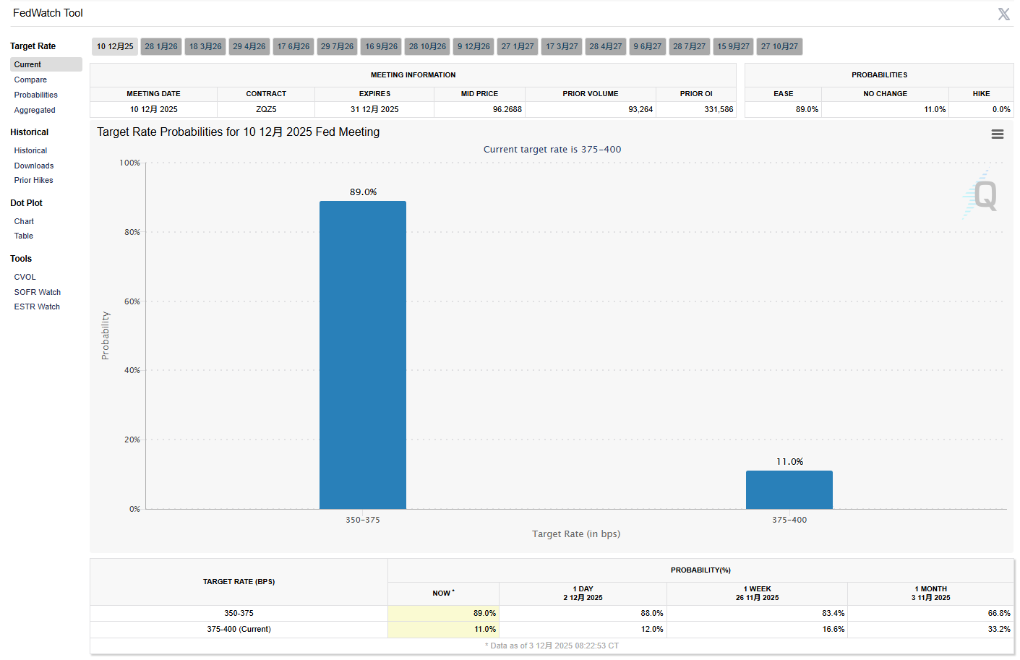
ADP employment data "unexpectedly weak", is a Federal Reserve rate cut imminent?
Glassnode Report: Current Structure Strikingly Similar to Pre-Crash 2022, Beware of a Key Range!

Coinglass report interprets Bitcoin's "life-or-death line": 96K becomes the battleground between bulls and bears—Is the ETF capital withdrawal an opportunity or a trap?
Bitcoin's price remains stable above the real market mean, but the market structure is similar to Q1 2022, with 25% of supply currently at a loss. The key support range is between $96.1K and $106K; breaking below this range will increase downside risk. ETF capital flows are negative, demand in both spot and derivatives markets is weakening, and volatility in the options market is underestimated. Summary generated by Mars AI. The accuracy and completeness of this summary are still being iteratively updated by the Mars AI model.

Trending news
MoreCrypto prices
More






