
Bitcoin: Strategy Falls, but Cantor Still Believes

In the midst of crypto turmoil, Cantor Fitzgerald surprises. The investment bank has drastically lowered its price target for Strategy, while stating that fears of forced liquidation are exaggerated. A decision that raises questions, since Strategy bets everything on bitcoin. What lies behind this downward revision, and what are the real risks for investors?

In brief
- Cantor Fitzgerald reduces its price target for Strategy (MSTR) by 60%, from $560 to $229.
- Strategy has $1.44 billion in cash, enough to cover its dividends for 21 months, limiting the risks of forced sales of its 650,000 bitcoins.
- Bitcoin remains decisive: its price movement will determine MSTR’s valuation and the outcome of risks related to exclusion from MSCI indices.
Cantor Fitzgerald halves its target for Strategy
Cantor Fitzgerald has shaken the markets by lowering its price target for Strategy from $560 to $229, a drop of 60%. A rare decision, even in as volatile a sector as crypto. This revision comes as Strategy’s (MSTR) stock has lost 35% since the beginning of the year and 27% in the last month. With a market cap of $53 billion, the company holds over 650,000 bitcoins, valued at about $55.7 billion at the current price.
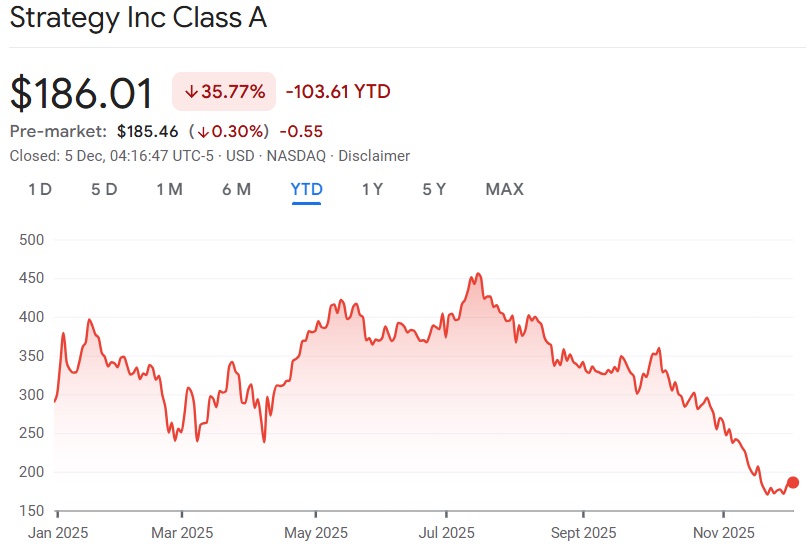 Strategy (MSTR) stock plunges.
This 60% cut by Cantor Fitzgerald on MSTR is partly explained by bitcoin’s price falling from $126,000 in October to about $86,000 in early December 2025. Worse yet, Strategy faces a major regulatory risk. MSCI is considering excluding companies with more than 50% of assets in crypto. This decision could trigger forced sales of MSTR worth $2.8 billion.
Strategy: why Cantor remains optimistic despite everything
Despite the drastic revision of its price target, Cantor Fitzgerald maintains an optimistic view on Strategy. The bank highlights several key strengths of the company, notably:
- The $1.44 billion cash reserve, raised in fiat currency and not in bitcoin;
- The ability to issue new shares to fund itself, reducing the risk of forced sales of its BTC holdings;
- The “leveraged bitcoin beta” of Strategy, a stock whose valuation almost entirely depends on bitcoin’s price.
Furthermore, Cantor Fitzgerald notes that liquidation fears would only be justified in an extreme bitcoin crash, with a 90% drop! A scenario analysts at the bank consider unlikely. Moreover, the bank views the recent correction as a healthy consolidation phase, necessary before a sustainable recovery.
Bitcoin: how its price dictates market decisions
Bitcoin’s price plays a central role in stock valuations, and Strategy is a perfect example. The correlation between BTC and MSTR prices is striking: when bitcoin falls, MSTR collapses. In November 2025, record outflows of $3.6 billion from bitcoin ETFs accelerated the decline of MSTR and the entire crypto sector. This dynamic shows how much bitcoin influences investors’ and analysts’ decisions.
Additionally, analysts’ decisions and indices like MSCI are directly influenced by bitcoin’s volatility. Therefore, a price recovery above $100,000 could revive MSTR and ease regulatory fears. Conversely, another decline would worsen pressure on Strategy and speed up its exclusion from indices.
Cantor Fitzgerald sent a clear message: Michael Saylor’s company is not in immediate danger, but its future remains closely tied to bitcoin’s. Between strong liquidity and regulatory risks, the company embodies the challenges and opportunities of a maturing crypto market. And you, would you be ready to bet on Strategy despite the uncertainties?
Disclaimer: The content of this article solely reflects the author's opinion and does not represent the platform in any capacity. This article is not intended to serve as a reference for making investment decisions.
You may also like
Zcash (ZEC) Value Soars: The Role of Privacy Coins After the Quantum Era
- Zcash (ZEC) surged 750% in 2025, outperforming Bitcoin , driven by demand for privacy amid regulatory crackdowns. - Its optional privacy model with zk-SNARKs and audit keys enabled compliance-friendly adoption on major exchanges. - Enterprise use cases like cross-border payments and institutional investments via Grayscale Trust boosted real-world utility. - Proactive post-quantum strategies, including quantum-resilient upgrades by 2026, position Zcash as a long-term privacy hedge.

The ZEC Price Rally: Unveiling the Driving Force Behind the Week-Long Surge
- Zcash (ZEC) surged to a four-year high of $300 in late November 2025, driven by blockchain upgrades and macroeconomic factors. - The Zashi cross-chain upgrade boosted privacy features, while Grayscale's Zcash Trust saw 228% AUM growth, signaling institutional adoption. - Fed rate cuts and inflation data accounted for 35% of ZEC's price volatility, reflecting crypto-traditional market correlations. - Analysts project $50-$120 ZEC prices by 2025 but caution regulatory risks and challenges in measuring priv

Zcash Halving and Its Impact on the Crypto Market: Understanding Limited Supply, Growing Institutional Interest, and Regulatory Challenges After the Halving
- Zcash's 2024 halving reduced block rewards by 50%, triggering a 700% price surge to $730 amid growing institutional interest in privacy-focused crypto assets. - Unlike Bitcoin's muted 2024 halving response, Zcash's smaller market cap amplified price volatility, with 28% of its supply now locked in shielded pools enhancing scarcity. - Regulatory risks under EU MiCA and U.S. AML policies threaten Zcash's privacy model, while a proposed Zcash ETF sparks debates over centralization versus mainstream adoption

3 Promising Altcoins to Buy Before the 2026 Bull Run

Trending news
MoreCrypto prices
More





