
Shiba Inu's 23.56 Trillion Token Movement Likely a Data Error

A reported movement of 23.56 trillion SHIB tokens in a single 24-hour period has raised questions among cryptocurrency observers. The figure, sourced from CryptoQuant's on-chain tracking data, appears extraordinary at face value. However, a closer examination of market behaviour and supporting metrics suggests the number reflects a technical anomaly rather than genuine market activity.
The sheer scale of the reported movement would typically trigger significant market reactions. Yet SHIB's price chart shows no corresponding volatility. The token continues to trade below its major moving averages, with no unusual price swings.
At the time of writing, SHIB is trading at around $0.000008416, indicating a 0.71% decline over the last 24 hours and a 9.5% weekly drop. This disconnect between reported volume and actual market behaviour points toward data misclassification rather than a real event.
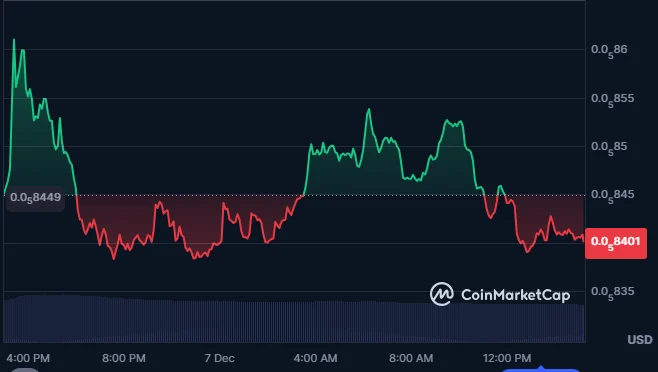
SHIB price chart, Source: CoinMarketCap
Market Shows No Signs of Massive Selling
When billions of tokens actually reach exchanges and enter circulation, markets respond. Traders see expanded bid-ask spreads. Price charts display violent candlestick patterns. Liquidity pools show clear signs of strain. None of these indicators appear in SHIB's recent trading history.
Trading volume remains within normal ranges. The price action shows typical consolidation patterns. No panic selling emerged. No sudden liquidity crunch occurred. The market is not pricing in a massive influx of new supply, which would be impossible to hide if trillions of tokens genuinely changed hands.
Exchange metrics provide additional evidence against the headline figure. While CryptoQuant data shows both inflows and outflows spiking to extreme levels, 24.4 trillion SHIB flowing in and 25.2 trillion flowing out, these numbers contain red flags. The charts display vertical jumps that suggest technical glitches rather than organic market movements.
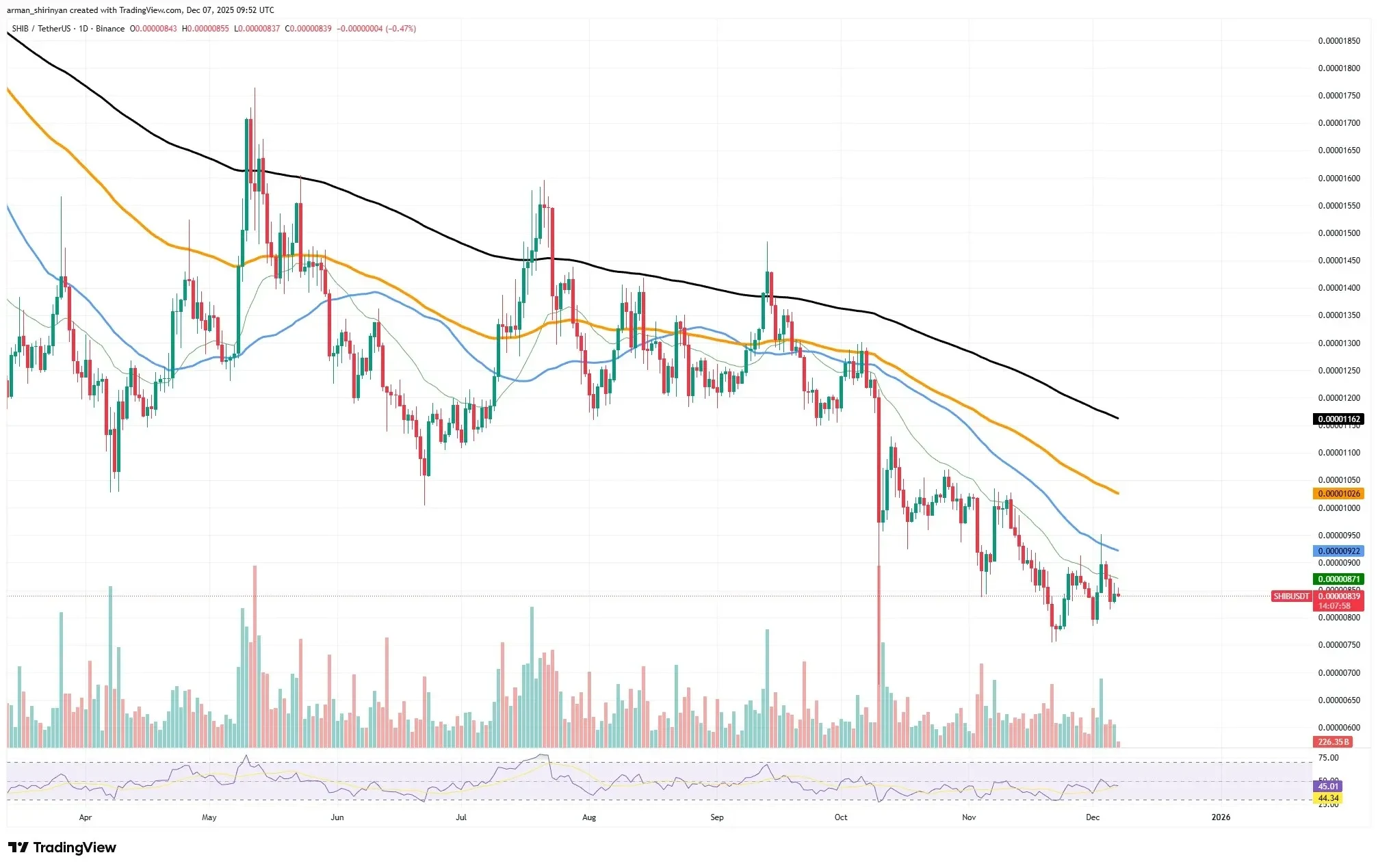
Wallet Reorganization Explains the Numbers
When both exchange inflows and outflows simultaneously register extreme values, internal wallet reorganization is usually the cause. Large holders regularly consolidate their positions across different wallets. Exchanges routinely move tokens between hot and cold storage. These internal transfers can trigger counting errors in blockchain tracking systems.
API errors represent another common source of inflated volume figures. Data indexing bugs occasionally cause the same transaction to be counted multiple times. Consolidation events where multiple wallets merge into one can be misread as fresh market activity. Each scenario produces misleading volume statistics without actual tokens hitting the open market.
Exchange reserve data supports this interpretation. The total amount of SHIB held on trading platforms has not shifted dramatically. If 23 trillion tokens genuinely moved to exchanges for selling, reserve balances would show a clear increase. They do not.
Active address counts tell a similar story. The number of unique wallets interacting with SHIB has not spiked. A legitimate movement of this magnitude would involve thousands of active participants. The blockchain would show clear evidence of widespread activity. That evidence does not exist.
Disclaimer: The content of this article solely reflects the author's opinion and does not represent the platform in any capacity. This article is not intended to serve as a reference for making investment decisions.
You may also like
The Growth of Wellness-Focused Sectors and Their Economic Impact
- Global health priorities shift from reactive care to proactive wellness post-pandemic, driven by academic, financial , and technological forces. - Academic curricula integrate interdisciplinary wellness education, emphasizing prevention and digital tools despite funding gaps. - Wellness economy grows to $6.8T in 2024, with mental health and digital therapeutics leading 12-19% annual growth amid aging populations. - Investors target gerontology and preventative care sectors, prioritizing longevity biotech

Netflix’s co-CEO talked about the Warner Bros. agreement with Trump
Short the Prediction Market
Mean Reversion of the Super Cycle of Speculation
Timeless Insights on Investing from 1927: How Human Behavior Continues to Shape Market Outcomes
- McNeel’s 1927 treatise and Buffett’s strategies emphasize intrinsic value and emotional discipline, countering market volatility through long-term focus. - Behavioral finance validates their approach, showing emotional biases like panic selling distort valuations during crises, while disciplined investors capitalize on dislocations. - Compounding through retained earnings, exemplified by Berkshire Hathaway’s Apple investments, highlights patience’s role in outperforming reactive market timing. - Modern v

Trending news
MoreCrypto prices
More





