
Tether Backs Generative Bionics in €70M Round to Advance Industrial Humanoid AI

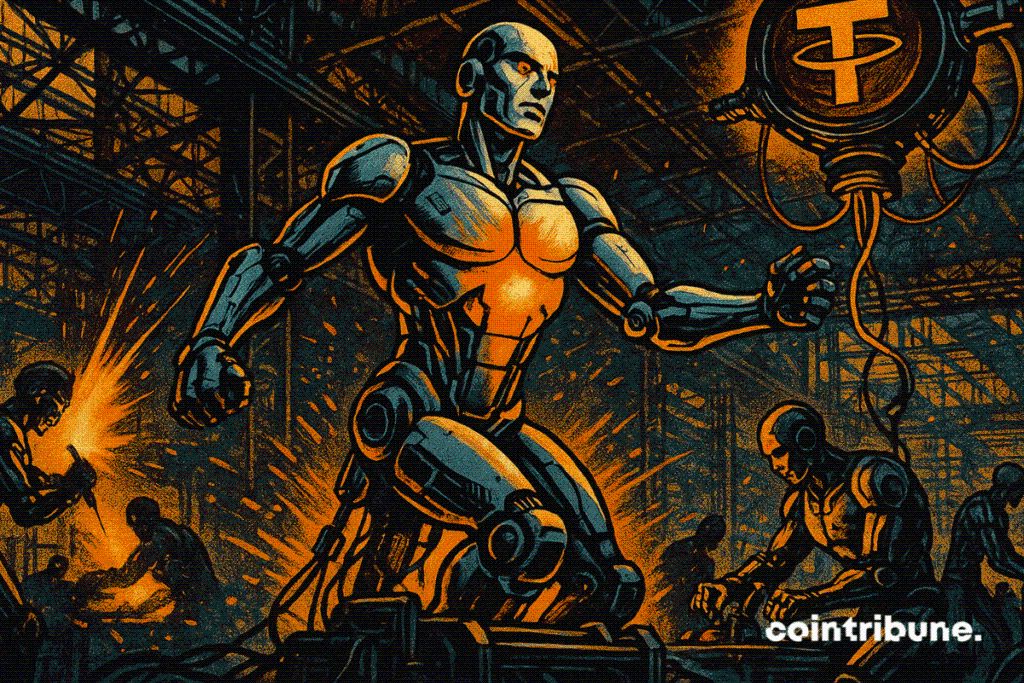
Tether’s investment arm has channelled fresh funding into Generative Bionics, a new venture born out of the Italian Institute of Technology. The company is developing advanced humanoid systems built for heavy-duty industrial settings. These machines are being designed to perform reliably under pressure, interact with people in a safe and natural way, and use high-level AI to manage demanding physical tasks.
In brief
- Tether teamed up with AMD Ventures, RoboIT, and other investors to provide €70 million in funding for Generative Bionics through CDP Venture Capital’s AI fund.
- Paolo Ardoino, Tether’s CEO, noted that the investment aims to strengthen essential infrastructure and support technologies that broaden human capability through robotics and AI.
- Generative Bionics is preparing its initial industrial contracts for early 2026 as it targets a growing global humanoid robotics market expected to reach trillions in value by 2050.
Investment Round and Growth Roadmap
Tether joined AMD Ventures, RoboIT, and other contributors in a €70 million funding round arranged through CDP Venture Capital’s Artificial Intelligence Fund. The investment aligns with the stablecoin issuer’s ongoing push into technologies that strengthen digital and physical infrastructure while supporting tools designed to expand human capability.
Generative Bionics explained that the new funds will accelerate several key stages of its development plan. The company intends to advance its product range, continue refining and training its physical AI systems, run industrial trials, and begin work on its first manufacturing facility. This progression marks an important step as the startup develops its humanoid systems and moves toward practical use.
Tether noted that its involvement fits within a broader strategy aimed at supporting technologies that reduce reliance on dominant tech platforms. This wider effort includes initiatives that expand its role in human-computer interaction and artificial intelligence:
- Supporting brain-computer interface initiatives through Blackrock Neurotech to advance human-machine capabilities.
- Partnering with Northern Data and Rumble to set up a 20,000-GPU global network aimed at open and privacy-conscious AI development.
Tether’s View and Industry Outlook
Paolo Ardoino, Tether’s chief executive, said the company directs its capital toward technologies that reinforce essential infrastructure while enabling innovations that broaden human capability. He described humanoid robotics and physical AI as a major leap forward in the practical use of intelligent systems and added that “Generative Bionics is building one of the most advanced platforms emerging from Europe.”
Looking ahead, Generative Bionics is preparing its initial industrial contracts, which are expected to be announced in early 2026. This comes as international forecasts indicate that the humanoid robotics sector could exceed €200 billion by 2035 and rise above $5 trillion by 2050, showing the scale of the opportunity the startup is targeting.
Market Rating Update and Tether’s Response
This news comes a few weeks after S&P Global lowered USDT’s stability rating to its lowest level, citing Tether’s increased holdings in Bitcoin and other assets with limited transparency. Ardoino challenged the assessment on X, arguing that long-standing rating practices have historically awarded strong marks to traditional institutions that later collapsed, prompting regulators to question the reliability of major agencies.
He added that established finance appears unsettled when firms point to weaknesses in the current system. Ardoino maintained that Tether holds excess reserves, avoids high-risk assets, and remains strongly profitable, which he views as evidence of deeper issues within traditional financial structures.
Disclaimer: The content of this article solely reflects the author's opinion and does not represent the platform in any capacity. This article is not intended to serve as a reference for making investment decisions.
You may also like
The Impact of Institutional Funding on Education and Workforce Training in Renewable Energy
- Institutional investors are boosting renewable energy education and workforce programs to drive long-term economic resilience and sustainability. - Global investments hit $386B in H1 2025, with education initiatives bridging skill gaps and enabling equitable clean energy transitions. - Case studies like Morocco’s 38% renewable electricity and Portugal’s green skills programs highlight education’s role in job creation and sector growth. - Education and green finance synergies in RCEP and U.S. $265B 2024 i

The Growing Influence of Artificial Intelligence on Universities and Preparing Tomorrow’s Workforce
- AI integration in higher education drives academic program expansion, with 2.5% undergraduate and 3% graduate enrollment growth in 2024. - Universities invest $33.9B in generative AI to modernize curricula and partner with industries , addressing 58% workforce readiness gaps. - AI-driven tools boost student retention (52% adoption) and project 1.5% U.S. GDP growth by 2035 through automation in key sectors. - Challenges persist: 71% academic integrity concerns and 52% training gaps highlight risks in AI a

The CFTC-Sanctioned Transformation in Clean Energy Trading
- CFTC's 2025 withdrawal of carbon credit derivatives guidance creates regulatory uncertainty but sparks innovation in blockchain/AI solutions. - OBBBA's 2026 construction deadline accelerates solar/wind project cancellations while preserving tax credit transferability mechanisms. - Battery storage, geothermal, and hydrogen emerge as resilient sectors amid market shifts, supported by IRA tax credits and OZ modernization. - Investors prioritizing domestic supply chains and third-party certified projects gai
Aligning university programs with new technology sectors to pinpoint areas with strong investment potential
- Higher education is redefining curricula to align with AI, quantum computing, green energy, and biotech sectors, addressing urgent talent gaps. - Green energy apprenticeships (e.g., ACE Network) and biotech-AI hybrid training programs are scaling rapidly to meet workforce demands. - Quantum computing initiatives like Connecticut's $1B QuantumCT plan highlight trillion-dollar investment potential in talent development and infrastructure. - AI ethics integration and edtech platforms for real-time labor mar
Trending news
MoreCrypto prices
More





