
Fed Cuts Rates Again Amid Growing Internal Division

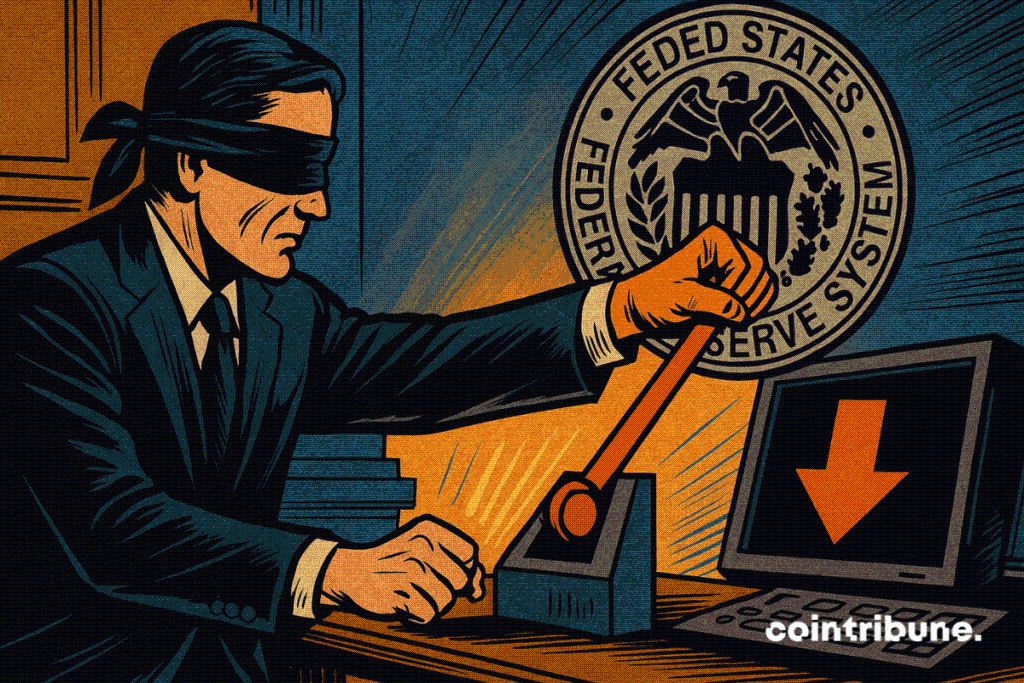
On December 10, the Fed announced a 25 basis point cut to its key interest rates, confirming market expectations. However, behind this seemingly routine decision lie deep divisions: split votes, unclear economic context, and unprecedented political pressures. In a context marked by the absence of key economic data due to the shutdown, interpreting the U.S. monetary strategy becomes increasingly complex and potentially destabilizing.
In brief
- The U.S. Federal Reserve lowered its key interest rates by 25 basis points, placing them between 3.50 % and 3.75 %.
- This is the third consecutive cut since September, amid an economic context marked by uncertainty.
- Two Fed members voted against this decision, while another advocated for a stronger 50-point cut.
- The lack of recent economic data, due to the shutdown, made decision-making particularly delicate.
An expected but controversial cut within the Fed
The U.S. Federal Reserve announced, on Wednesday, December 10, a new 25 basis point cut to its key interest rates as markets had anticipated , bringing the Fed Funds Rate range to 3.50 % – 3.75 %.
This marks the third consecutive cut since September. This decision, although expected by markets, was not unanimous within the monetary policy committee. According to the official statement , “uncertainty regarding economic prospects remains high”, and the committee “judges that downside risks to employment have increased in recent months”.
The internal dissensions , rarely so marked, were made public :
- Two members voted against the rate cut : Jeffrey Schmid (Kansas City) and Austan Goolsbee (Chicago), both supporters of the status quo ;
- One member, Stephen Miran, recently appointed by Donald Trump, distinguished himself by voting for a more aggressive 50 basis point reduction ;
- This division reflects a deep disagreement on the strategy to adopt in an still unclear economic context.
This tension is also explained by the lack of updated on-chain economic data, a direct consequence of the extended U.S. government shutdown. The latest available unemployment rate, from September, is 4.4 %, while inflation then reached 2.8 %, above the 2 % target.
Several key indicators, such as job creation and consumption data, have not been published for several weeks, leaving the Fed in a delicate position. Due to lack of visibility, some members preferred to wait, while others judged it necessary to act now to support the labor market.
A Fed under political pressure at the dawn of 2026
Beyond internal tensions, this monetary decision comes in a particularly sensitive political context.
President Donald Trump has intensified his criticism of Jerome Powell, whom he blames for monetary policy still too restrictive. Powell’s term expires in spring 2026, and the White House has already launched consultations to replace him with a more accommodative profile.
According to several sources, Kevin Hassett, former economic advisor to Trump, is among the favorites . Trump makes no secret that he expects the future Fed chair to lead a more accommodative policy. This growing politicization of the central bank fuels concerns about the institution’s future independence.
In parallel, the composition of the FOMC will evolve in 2026: four new voting members from regional banks will join the committee, according to the usual rotation system. This renewal could change the internal balance of debates, especially if profiles more favorable to low rates are appointed or promoted by the executive.
In the economic projections published this Wednesday, the Fed anticipates only one rate cut for 2026, while markets expect two. This divergence between the institution’s discourse and market expectations increases uncertainty, notably for investors seeking visibility.
The Fed resists Trump and maintains its stance despite political pressures. By opting for a measured cut, it asserts its independence while accommodating the markets. The question remains whether this stance will hold against the economic tensions of 2026 and investors’ growing expectations.
Disclaimer: The content of this article solely reflects the author's opinion and does not represent the platform in any capacity. This article is not intended to serve as a reference for making investment decisions.
You may also like
The Rise of a Dynamic Clean Energy Market: Ushering in a New Age for VPPA Transactions
- CleanTrade, a CFTC-approved platform, addresses fragmented clean energy markets with transparent VPPA trading. - It enables institutional investors to manage risks and optimize yields via real-time liquidity and standardized pricing. - The platform's $16B notional value highlights growing demand for structured risk tools in renewables. - Regulatory oversight and data-driven analytics enhance credibility, fostering institutional confidence in clean energy investments.

Do Kwon to Serve 15 Years Behind Bars for the $40B LUNA Fraud
 VIPBitget VIP Weekly Research Insights
Global risk assets are entering a phase where multiple catalysts are aligning, driving a new wave of momentum in technology and growth stocks. Trump has revived his "tariff dividend" proposal (a $2000 check per person), the U.S. government shutdown crisis is nearing resolution (with fiscal spending expected to resume before December 11), and the probability of a Fed rate cut in December has surged to 95% (with markets even partially pricing in a 50-basis-point cut). Expectations of ample liquidity are rising across the board. U.S. tech stocks and high-beta growth names are positioned to benefit first. Themes such as AI infrastructure, retail brokers (supported by the convergence of crypto and U.S. stock trading), and digital-asset infrastructure are likely to lead the rally. The Nasdaq index is expected to see further upside in the near term, while select quality stocks offer notable rebound potential. As a globally leading Universal Exchange (UEX), Bitget has fully integrated tokenized stocks and futures products, bridging traditional finance with the wider digital-asset ecosystem. Through strategic partnerships with institutions such as Ondo Finance, Bitget Onchain now supports on-chain tokenized trading for more than 100 stocks and ETFs. Users can trade tokenized stocks—including NVDA, HOOD, TSLA, MSTR, COIN, META, and other popular names—directly in the spot market, and also access perpetual futures on individual stocks within Bitget's futures section.

Investing in Health-Focused Industries: A Strategic Transformation in Consumer and Business Practices
- Global wellness economy is transforming through health, financial , and environmental priorities, driven by consumer demand, corporate innovation, and policy shifts. - Health wellness market projected to grow from $3.8T to $5.27T by 2033, fueled by AI adoption, wearables, and preventive care advancements. - Sustainable living sector will expand 3.8x to $29.97B by 2033, accelerated by green tech (23.1% CAGR) and corporate net-zero commitments. - Financial wellness tech grows at 10.25% CAGR, with AI-driven

Trending news
MoreCrypto prices
More





