
MENA Emerges as Global Growth Engine for Blockchain Gaming, BGA 2025 Report Finds

The Middle East and North Africa (MENA) now account for nearly 20% of the global blockchain gaming workforce. This marks the largest regional shift in industry history.
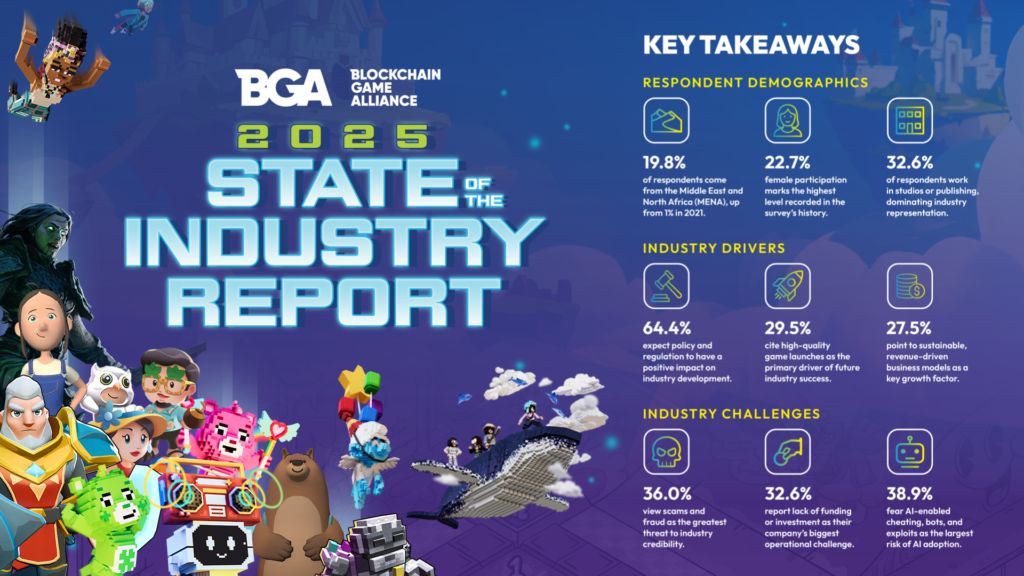
The Blockchain Game Alliance’s 2025 State of the Industry Report, released at the Global Blockchain Show Abu Dhabi on December 10, 2025, highlights a dramatic shift in global talent. MENA rose from just 0.5% in 2021 to 19.8% in 2025—the fastest growth since tracking began.
Explosive Growth Reshapes Regional Demographics
The BGA’s fifth annual survey signals a fundamental rebalancing of the blockchain gaming landscape. Western markets are contracting, while other regions are accelerating digital infrastructure and strengthening regulatory frameworks.
The survey collected 506 valid responses in 2025, fewer than 623 in 2024. Western market contractions contributed to this decline. However, emerging regions showed real growth: Africa now has 5.5% of industry professionals, and Latin America 11.9%, pointing to a clear pivot away from traditional Asian and European dominance.
Female participation hit a record 22.7%, up from 17.3% in 2024. The highest concentration was among professionals aged 25 to 44. Youth-driven expansion continues in MENA and Africa. Notably, 40% of African respondents are under 25 years old.
Regulation and Quality Lead Industry Priorities
Professionals now rank regulatory clarity as the most critical factor for the future of blockchain gaming. An overwhelming 64.4% expect policy and regulation to shape the industry positively. This shows growing belief that legitimacy depends on clear legal frameworks.
MENA countries have moved quickly in developing regulations. The UAE, Bahrain, and Morocco are piloting or regulating stablecoin frameworks. This positions the region as a leader in payment innovation. For instance, Oman experienced a 700% surge in digital payments within one year. Digital wallets now enable 74% of transactions, supporting blockchain-based economies with advanced financial systems.
High-quality game launches ranked second among key drivers at 29.5%. This shows a move away from past speculative models. Sustainable, revenue-driven business models ranked third at 27.5%. Stablecoins drew 27.3% support as tools for cross-border payments and in-game transactions.
Studios have adopted product-first approaches after significant market contraction. Blockchain gaming funding plunged from over $10 billion in 2022 to $293 million in 2025. Studios now focus on real revenue rather than token speculation. Guild participation dropped from 20.7% in 2022 to 7.9% in 2025, as unsustainable models collapsed.
Fraud, Funding Scarcity, and AI Emerge as Top Threats
Despite momentum, the industry faces serious obstacles. Scams and fraud remain top threats, cited by 36.0% of respondents. Rug pulls and exploitative schemes still hinder mainstream adoption, especially for risk-averse gamers.
Funding scarcity is another challenge, ranking second at 32.6%. The capital drought has forced 80% to 93% of startups to close since 2021. Major venture capital firms have paused new investments. Studios must now prove profitability and sustainability.
Artificial intelligence presents both promise and risk. Although 46% see AI as a growth driver for marketing or content creation, 38.9% worry about AI-enabled exploitation. Concerns include increased cheating, generic content, and potential loss of creative authenticity.
Digital Infrastructure Fuels MENA’s Competitive Edge
MENA’s growth reflects more than pro-innovation regulation. The region’s digitally native population boasts high financial literacy and risk tolerance, crucial for blockchain adoption. Nearly 45% of MENA traders start with demo accounts, signaling widespread demand for economic education. Regional clients achieve strong win rates and show the world’s highest risk appetite.
Modern payment systems play a key role. Many countries deployed real-time settlement systems, automated clearinghouses, and mobile platforms. These cuts reduce transaction costs and shorten settlement times, enabling cross-border value transfers vital to blockchain gaming economies.
Major studios have taken notice. BGA survey respondents include staff from Ubisoft, Square Enix, Cointelegraph, Polygon Labs, DMCC Dubai, and leading regional financial institutions. Traditional gaming and blockchain companies are converging. As publishers explore Web3, they integrate new tech without abandoning proven models.
Globally, stablecoins processed $27.6 trillion in 2024, with MENA leading retail payment innovation. The region’s focus on regulation, infrastructure, and user expertise positions it well as blockchain gaming moves from niche to mainstream.
Industry Navigates Contraction Toward 2026 Recovery
Web3 token prices dropped 90% to 95% from prior highs. Studios are moving away from token-driven models. Now, they prefer traditional revenue with blockchain elements. Although many projects failed, survivors show stronger fundamentals. Studios with solid intellectual property and sustainable economics attract investor interest after two years of limited funding.
MENA’s rise comes as the sector matures. Regional developers benefit from stable regulation, diversified revenue, and capital from institutional investors and sovereign wealth funds.
Looking ahead to 2026, the industry’s focus is on whether quality game launches can deliver long-awaited results. MENA’s infrastructure, talent, and regulatory environment give it a competitive edge. However, broad success will depend on creating games people choose for their entertainment value—not just for financial incentives. The coming year will show if MENA can fulfill the promise of becoming blockchain gaming’s growth engine.
Disclaimer: The content of this article solely reflects the author's opinion and does not represent the platform in any capacity. This article is not intended to serve as a reference for making investment decisions.
You may also like
The Financial Wellness Aspect: The Influence of Investor Actions on Market Results
- Behavioral economics integrates psychology to explain how emotional, intellectual, and environmental wellness shape investor decisions and market outcomes. - Emotional resilience reduces cognitive biases like loss aversion, while intellectual engagement through AI tools improves long-term investment returns according to 2024-2025 studies. - Environmental factors such as ESG frameworks and workplace wellness programs demonstrate measurable economic benefits, including 20% higher productivity and reduced f
Regulatory Changes in U.S. Agriculture: The Impact of USDA Policy Decisions on Long-Term Investments in Livestock and Poultry Industries
- USDA’s 2023–2025 Organic Livestock and Poultry Standards (OLPS) impose stricter animal welfare rules, with phased compliance until 2029 to ease small producers’ adjustments. - Compliance costs for organic producers are high initially but projected to yield $59.1–$78.1 million annual benefits via enhanced consumer trust and premium pricing. - Investors favor scalable, tech-driven operations amid OLPS-driven capital shifts, though small producers face compliance challenges and market exit risks in poultry

ZK Atlas Enhancement: Marking a Milestone for Scalable Blockchain Frameworks
- ZKsync's 2025 Atlas Upgrade revolutionizes blockchain with 43,000 TPS, $0.0001 per-transaction costs, and sub-second finality via Airbender zkVM. - Modular EVM compatibility attracts Deutsche Bank , Sony , and $15B institutional investment, accelerating DeFi, NFTs, and cross-border payments. - ZK rollups' TVL surges to $28B, with 60.7% CAGR projected through 2031, driven by Bitcoin ETF inflows and $7.59B ZKP market growth by 2033. - Regulatory clarity under U.S. GENIUS Act and EU MiCA accelerates adoptio

ZK (Zero-Knowledge) Technology and Its Rapidly Growing Market Attention
- Zero-knowledge (ZK) technology is revolutionizing blockchain and fintech by enabling scalable, private, and compliant systems, with the ZKP market projected to grow from $1.535B in 2025 to $7.585B by 2033 at 22.1% CAGR. - Institutional adoption by firms like Goldman Sachs , Walmart , and HSBC highlights ZK's role in confidential transactions and supply chain transparency, supported by regulatory frameworks like the U.S. GENIUS Act and EU MiCA. - Enterprise platforms (Quorum, Hyperledger Fabric-X) and inn

Trending news
MoreCrypto prices
More





