
With a 60% plunge in market share, can Hyperliquid return to the top with HIP-3 and Builder Codes?

What has Hyperliquid experienced recently?
Original Title: Hyperliquid Growth Situation
Original Author: @esprisi0
Translation: Peggy, BlockBeats
Editor's Note: Hyperliquid once dominated the decentralized derivatives sector, but its market share plummeted sharply in the second half of 2025, drawing industry attention: has it peaked, or is it laying out the next stage? This article reviews Hyperliquid’s three phases: from a peak market share of 80% and extreme dominance, to a loss of momentum dropping to 20% due to strategic transformation and intensified competition, and finally to a resurgence centered on HIP-3 and Builder Codes.
The following is the original text:
In recent weeks, concerns about Hyperliquid’s future have been mounting. The loss of market share, rapidly rising competitors, and an increasingly crowded derivatives track have raised a key question: what is really happening beneath the surface? Has Hyperliquid already peaked, or is the current narrative overlooking deeper structural signals?
This article will break it down one by one.
Phase One: Extreme Dominance
From early 2023 to mid-2025, Hyperliquid continuously set new historical highs on key metrics and steadily increased its market share, thanks to several structural advantages:
An incentive mechanism based on points attracted massive liquidity; a first-mover advantage in launching new perpetual contracts (such as $TRUMP, $BERA) made Hyperliquid the most liquid venue for new trading pairs and the preferred platform for pre-listing trading (such as $PUMP, $WLFI, XPL). To avoid missing emerging trends, traders were forced to flock to Hyperliquid, pushing its competitive edge to the peak; among all perpetual DEXs, it offered the best UI/UX experience; fees were lower than centralized exchanges (CEX); spot trading was launched, unlocking new use cases; Builder Codes, HIP-2, and HyperEVM integration; and even during major market crashes, it achieved zero downtime.
As a result, Hyperliquid’s market share grew for over a year, reaching a peak of 80% in May 2025.
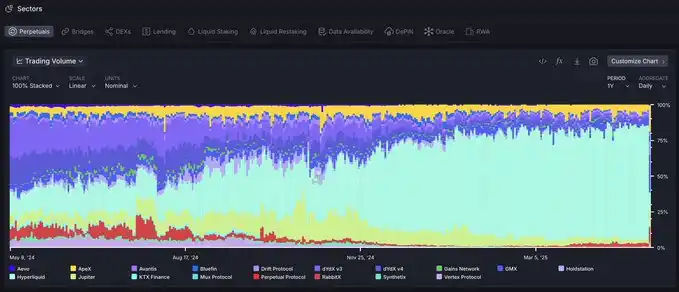
Perpetual contract trading volume market share data provided by @artemis
At that stage, the Hyperliquid team was clearly ahead of the entire market in terms of innovation and execution speed, with no truly comparable product in the entire ecosystem.
Phase Two: The Rise of "Liquidity AWS" and Accelerated Competition
Since May 2025, Hyperliquid’s market share has plummeted, dropping from about 80% to nearly 20% of trading volume by early December.
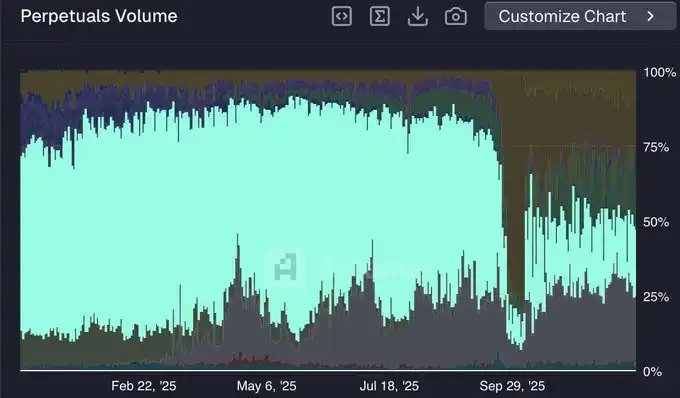
@HyperliquidX market share (data source: @artemis)
This relative loss of momentum compared to competitors can be attributed to several factors:
Strategic Shift from B2C to B2B
Hyperliquid did not double down on the pure B2C model, such as launching its own mobile app or continuously rolling out new perpetual contract products. Instead, it chose to shift to a B2B strategy, positioning itself as the "AWS of liquidity."
This strategy focused on building core infrastructure for external developers, such as Builder Codes for frontends and HIP-3 for launching new perpetual markets. However, this transformation essentially handed over the initiative of product deployment to third parties.
In the short term, this strategy was not ideal for attracting and retaining liquidity. The infrastructure was still in its early stages, adoption takes time, and external developers did not yet have the distribution capability and trust that the Hyperliquid core team had built up over the long term.
Competitors Seizing the Opportunity During Hyperliquid’s Transition
Unlike Hyperliquid’s new B2B model, competitors remained fully vertically integrated, allowing them to significantly accelerate the launch of new products.
Because they did not need to delegate execution, these platforms maintained full control over product launches and quickly expanded by leveraging their established user trust. As a result, they became more competitive than in the first phase.
This directly translated into market share growth. Competitors now not only offered all the products available on Hyperliquid, but also launched features not yet available on HL (for example, Lighter introduced spot markets, perpetual stocks, and forex).
Incentives and "Mercenary Liquidity"
Hyperliquid has not run any official incentive programs for over a year, while its main competitors remain active. The current market share leader in trading volume, Lighter (about 25%), is still in the pre-TGE points season.
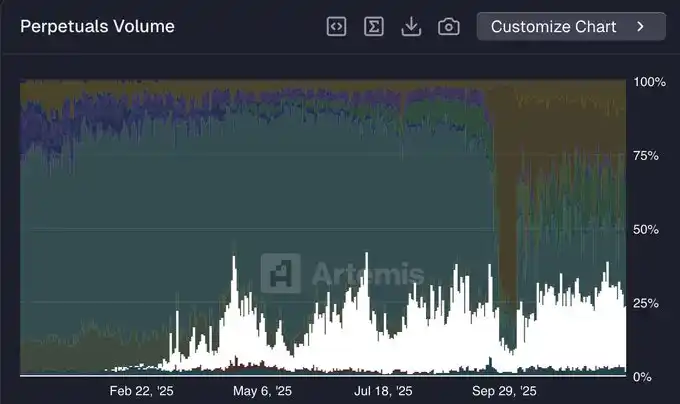
@Lighter_xyz market share (data source: @artemis)
In DeFi, liquidity is more "mercenary" than anywhere else. A significant portion of the trading volume flowing from Hyperliquid to Lighter (and other platforms) is likely driven by incentives and related to airdrop farming. Like most perpetual DEXs running points seasons, Lighter’s market share is expected to decline after TGE.
Phase Three: The Rise of HIP-3 and Builder Codes
As mentioned earlier, building the "AWS of liquidity" is not the optimal short-term strategy. However, in the long run, this model is precisely what gives Hyperliquid the potential to become the core hub of global finance.
Although competitors have already copied most of Hyperliquid’s current features, true innovation still originates from Hyperliquid. Developers building on Hyperliquid benefit from domain specialization, allowing them to formulate more targeted product development strategies on top of ever-evolving infrastructure. In contrast, protocols like Lighter, which remain fully vertically integrated, will face limitations when optimizing the development of multiple product lines simultaneously.
HIP-3 is still in its early stages, but its long-term impact is already beginning to show. The main participants include:
@tradexyz has launched perpetual stocks
@hyenatrade recently deployed a trading terminal for USDe
More experimental markets are emerging, such as @ventuals offering pre-IPO exposure, and @trovemarkets targeting niche speculative markets like Pokémon or CS:GO assets
It is expected that by 2026, HIP-3 markets will account for a significant share of Hyperliquid’s total trading volume.
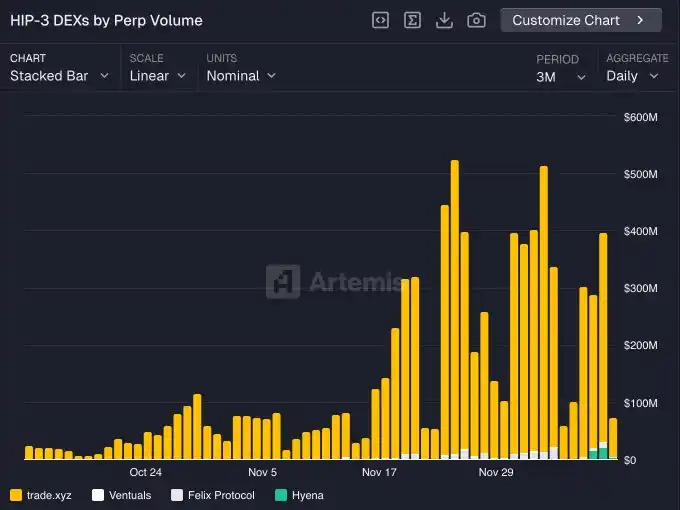
HIP-3 trading volume (by Builder)
The key driver that will ultimately restore Hyperliquid’s dominance is the synergy between HIP-3 and Builder Codes. Any frontend integrated with Hyperliquid can instantly access the full HIP-3 market, thereby offering users unique products.
Therefore, developers are strongly motivated to launch markets via HIP-3, as these markets can be distributed on any compatible frontend (such as Phantom, MetaMask, etc.) and tap into entirely new sources of liquidity. This is a perfect virtuous cycle.
The continued development of Builder Codes makes me more optimistic about the future, both in terms of revenue growth and active user growth.
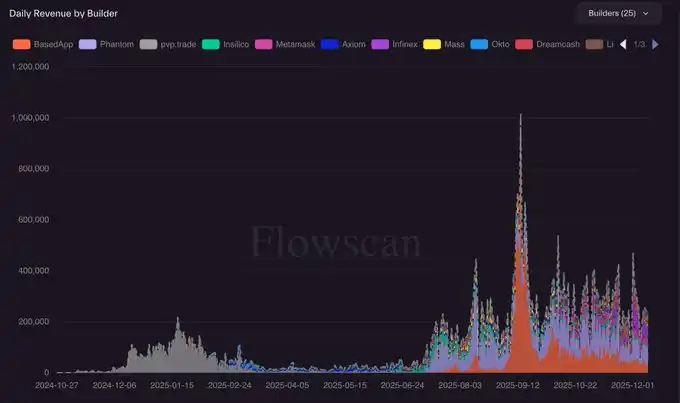
Builder Codes revenue (data source: @hydromancerxyz)
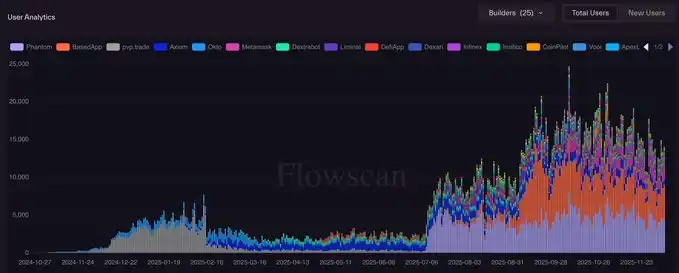
Builder Codes daily active users (data source: @hydromancerxyz)
Currently, Builder Codes are mainly used by crypto-native applications (such as Phantom, MetaMask, BasedApp, etc.). However, I expect that in the future, a new class of super apps built on Hyperliquid will emerge, aiming to attract entirely non-crypto-native new user groups.
This is likely to become the key path for Hyperliquid to scale to the next stage, and will be the focus of my next article.
Disclaimer: The content of this article solely reflects the author's opinion and does not represent the platform in any capacity. This article is not intended to serve as a reference for making investment decisions.
You may also like

XRP sinks below $2 despite $1B in ETF inflows: How low can price go?

Beyond Trading: A Look at Star New Projects and Major Updates in the Solana Ecosystem
The Solana Breakpoint 2025 conference was truly spectacular.

Quick Look at the 33 Winning Projects of the Solana Breakpoint 2025 Hackathon
Over 9,000 participants formed teams and submitted 1,576 projects, with a total of 33 projects winning awards. All of them are top industry seed projects selected from hundreds.

Trending news
MoreCrypto prices
More





