
Banks warn of risk of $6,6 trillion migration to stablecoins

- US Banks Predict Trillion-Dollar Migration to Stablecoins
- GENIUS Law may have a loophole for indirect income
- Crypto sector criticizes warning and accuses defense of profits
A coalition of US banking groups, led by the Bank Policy Institute (BPI), has called on Congress to revise the language of the recently passed GENIUS Act for stablecoins, pointing to a loophole that could trigger the transfer of up to $6,6 trillion in bank deposits into digital assets.
The BPI recognized that the law already prohibits stablecoin issuers from paying yields or interest directly to holders. However, he emphasized that the current wording does not prevent cryptocurrency exchanges or affiliated companies from partnering with issuers to offer indirect earnings.
According to the group, this possibility would pose a significant risk to the traditional banking system, reducing lending capacity, raising interest rates, and increasing credit costs for businesses and households. "Congress must protect the flow of credit to American businesses and households and the stability of the most important financial market by closing the stablecoin interest payment loophole," the group stated.
The stance drew immediate backlash from the crypto sector. Coinbase's chief legal officer, Paul Grewal, called the concern overblown, noting that similar proposals have already been rejected by Congress.
"This wasn't a loophole, and you know it. 376 Democrats and Republicans in the House and Senate rejected your unbridled effort to prevent competition. A president did it too."
declared.
Coinbase CEO Brian Armstrong echoed the criticism, suggesting that banks are more interested in protecting profit margins than avoiding systemic risks. Jake Chervinsky, general counsel at Variant Fund, added that the regulatory influence of financial institutions has been insufficient to prevent the sector's evolution and that the warning's motivations are primarily self-preservation.
Mikko Ohtama, co-founder of Trading Protocol, argued that banks' resistance is linked to the impact of stablecoins on traditional deposit models. He believes the solution lies in improving savings account offerings and similar products. "People won't withdraw money from banks if they offer them a good deal," he concluded.
Disclaimer: The content of this article solely reflects the author's opinion and does not represent the platform in any capacity. This article is not intended to serve as a reference for making investment decisions.
You may also like
Powell: Employment is weakening, inflation remains high, and no one is talking about rate hikes now
Powell pointed out that the U.S. labor market is cooling, with hiring and layoffs slowing down and the unemployment rate rising to 4.4%. Core PCE inflation remains above the 2% target, but service inflation is slowing. The Federal Reserve has cut interest rates by 25 basis points and started purchasing short-term Treasury bonds, emphasizing that the policy path needs to balance risks between employment and inflation. Future policies will be adjusted based on data. Summary generated by Mars AI. This summary is produced by the Mars AI model, and the accuracy and completeness of its generated content are still in the process of iterative improvement.
$RAVE TGE Countdown: When Clubbing Becomes an On-Chain Economic Activity, the True Web3 Breakthrough Moment Arrives
RaveDAO is rapidly growing into an open cultural ecosystem driven by entertainment, becoming a key infrastructure for Web3 to achieve real-world adoption and mainstream breakthrough.
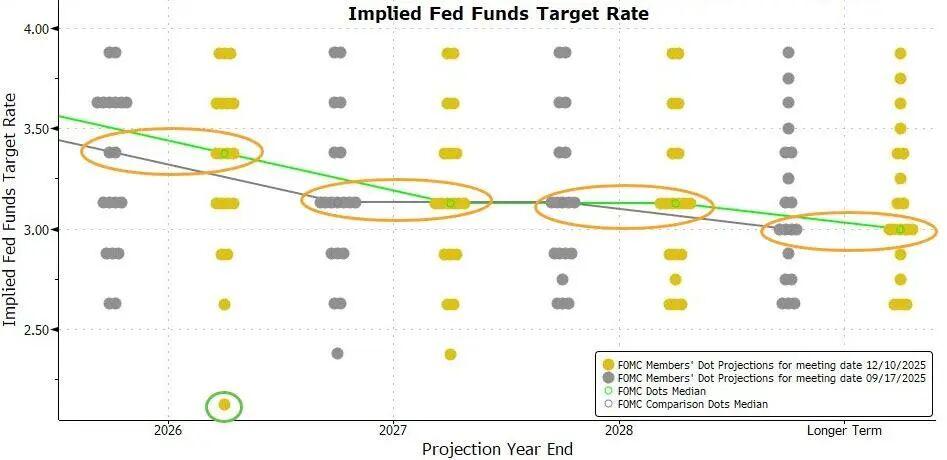
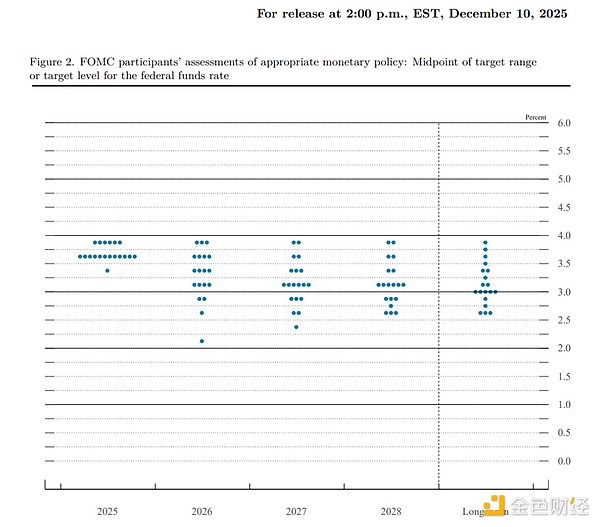
A "hawkish rate cut" that's not so "hawkish," and balance sheet expansion that's "not QE"
The Federal Reserve has cut interest rates by another 25 basis points as expected, still projecting one rate cut next year, and has launched an RMP to purchase $40 billion in short-term bonds.
Trending news
MoreCrypto prices
More





